Best Cash Back Credit Cards of 2026: Top Picks Ranked by Spending Category
Best cash back credit cards of 2026 ranked by spending category. Wells Fargo Active Cash leads for flat-rate simplicity; Blue Cash Preferred wins for grocery households spending $500+/month.
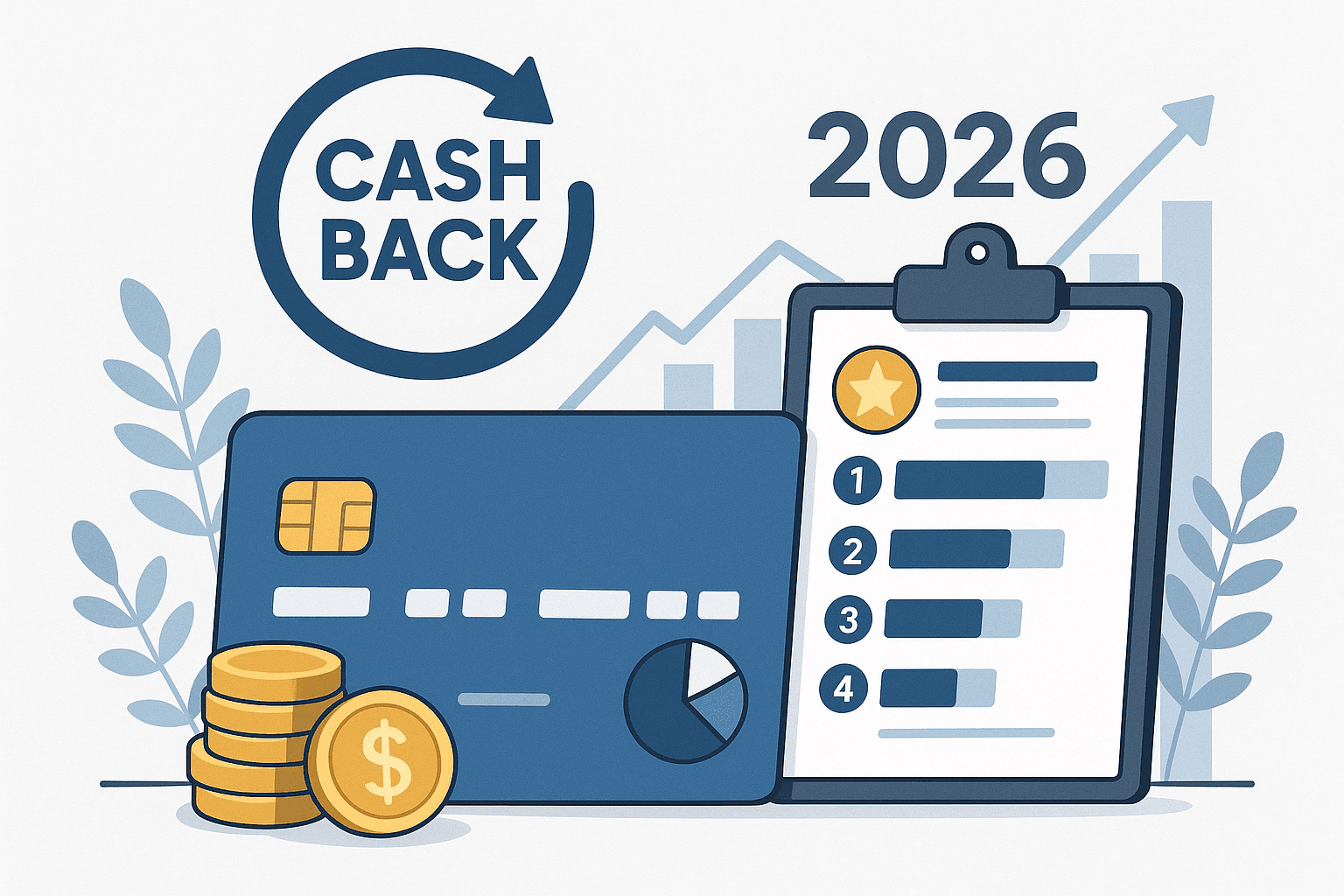
If you're looking for the best cash back credit card in 2026, the Wells Fargo Active Cash leads for flat-rate simplicity (2% on everything, no annual fee) while the Blue Cash Preferred from American Express wins for grocery-heavy households (6% back at US supermarkets). We evaluated 7 top cards across base earn rate, category bonuses, annual fee math, sign-up bonus value, and redemption flexibility. This guide helps you match the right card to your actual spending pattern, not the card that pays the highest referral commission.
How We Ranked These Cards
We evaluated each card across 5 criteria:
| Criteria | Weight | Why It Matters |
|---|---|---|
| Effective Cash Back Rate | High | Net return after fees on realistic spend |
| Category Bonus Structure | High | Where you actually spend determines which card wins |
| Annual Fee vs. Rewards Math | High | Fee-free cards must still be justified by net return |
| Sign-Up Bonus Value | Medium | One-time but meaningful to total first-year value |
| Redemption Flexibility | Medium | Restrictive redemption reduces real-world value |
Data sources: Consumer Financial Protection Bureau (CFPB) credit card data, Bankrate 2026 credit card survey, issuer published reward terms.
1. Wells Fargo Active Cash® Card — Best Flat-Rate Cash Back
Best for: Simplicity seekers who want maximum return without tracking categories
Earn Rate: 2% cash rewards on all purchases
Annual Fee: $0
Sign-Up Bonus: $200 after $500 spend in 3 months
The Wells Fargo Active Cash earns 2% cash back on every purchase with no categories to track, no rotating bonuses, and no annual fee. For the average cardholder spending $2,000/month, that's $480/year in cash back with zero optimization required. This is the best default card for people who want one card that simply works.
Pros
- 2% flat rate beats most no-annual-fee category cards on blended spend
- No activation, no caps, no rotating categories to track
- Cell phone protection up to $600 included (with monthly payment on the card)
Cons
- Loses to category cards for grocery, dining, or travel heavy spenders
- 3% foreign transaction fee — not for international use
- Cash back earns as "rewards dollars" — requires redemption into bank account
Who This Is Best For
Anyone who wants to set it and forget it. Ideal as a catch-all card paired with a category-specific card. Not the right choice if you spend heavily in grocery, dining, or travel where category cards earn 3–6%.
2. Blue Cash Preferred® Card from American Express — Best for Grocery Spenders
Best for: Households spending $500+/month at US supermarkets
Earn Rate: 6% at US supermarkets (up to $6,000/year), 3% on transit and gas, 1% elsewhere
Annual Fee: $95/year (waived first year)
Sign-Up Bonus: $250 after $3,000 spend in 6 months
At 6% back on groceries, a household spending $500/month at US supermarkets earns $360/year in grocery cash back alone — netting $265 after the $95 fee. That's before gas and transit bonuses. For families with $600+/month in grocery spend, this card delivers the highest net return of any no-category-cap card.
Pros
- 6% grocery rate is the highest of any major cash back card
- 3% on transit (Uber, subway, tolls) is genuinely useful for commuters
- $250 sign-up bonus effectively makes the first year free
Cons
- 6% rate caps at $6,000 in annual supermarket spend ($500/month)
- $95 annual fee requires $525+/month in grocery spend to justify vs. no-fee alternatives
- Supermarkets only — warehouse clubs (Costco, Sam's Club) and superstores (Target, Walmart) excluded
Who This Is Best For
Families spending $500–$700/month at traditional supermarkets. Run the math: multiply your monthly grocery spend by 0.06, annualize it, subtract $95. If positive, this card wins. Not worth it for small households with under $400/month in grocery spend.
3. Citi Double Cash® Card — Best for Disciplined Full Payers
Best for: People who pay their balance in full every month
Earn Rate: 2% total (1% when you buy + 1% when you pay)
Annual Fee: $0
Sign-Up Bonus: $200 after $1,500 spend in 6 months (as Citi Cash Back)
The Citi Double Cash earns 2% total — 1% when you purchase, 1% when you pay — effectively making it a 2% cash back card for full payers. Rewards can also be converted to Citi ThankYou points and transferred to airline and hotel partners, giving it hidden value for aspirational travelers who primarily want cash back.
Pros
- 2% effective rate with no annual fee
- Optional ThankYou points conversion for premium redemption flexibility
- Long 0% APR intro period on balance transfers (18 months)
Cons
- The 1%+1% structure means you only earn full value if you pay in full
- No bonus categories for heavy spenders in specific verticals
- Balance transfer fee (3%) applies
Who This Is Best For
Disciplined full-payers who may occasionally want to leverage points for travel, or those looking for a card that does double duty (cash back + transfer partner access). Not ideal for anyone who carries a balance — the second 1% disappears.
4. Chase Freedom Unlimited® — Best for New Cardholders
Best for: Chase ecosystem users and new-to-rewards cardholders
Earn Rate: 5% on travel via Chase, 3% on dining and drugstores, 1.5% on everything else
Annual Fee: $0
Sign-Up Bonus: $200 after $500 spend in 3 months
The Chase Freedom Unlimited offers 1.5% base rate plus elevated dining (3%) and pharmacy (3%) bonuses, all with no annual fee. Its real value is as a points-earning vehicle within the Chase ecosystem — paired with a Sapphire Reserve or Preferred, points transfer to United, Hyatt, and Southwest at 1.5–2x value.
Pros
- 3% on dining is best-in-class among no-fee cards
- Pairs powerfully with Chase Sapphire for travel redemption
- Easy $200 bonus with only $500 spend threshold
Cons
- 1.5% base rate trails Wells Fargo Active Cash (2%) for non-bonus purchases
- Full value requires Chase ecosystem engagement (Sapphire card pairing)
- 3% foreign transaction fee
Who This Is Best For
Chase ecosystem users who dine out frequently and want a no-fee cash back card. Also the best entry point for points optimization beginners — the Chase ecosystem is the most accessible premium travel rewards system.
5. Discover it® Cash Back — Best for Rotating Category Maximizers
Best for: Engaged cardholders who optimize quarterly categories
Earn Rate: 5% on quarterly rotating categories (up to $1,500/quarter), 1% elsewhere
Annual Fee: $0
Sign-Up Bonus: Cashback Match — Discover matches all first-year earnings
Discover's Cashback Match program doubles all first-year earnings — effectively making this a 10% cash back card on rotating categories and 2% on everything in year one. Quarterly categories historically include Amazon, gas stations, grocery stores, and restaurants. Activation required each quarter.
Pros
- Cashback Match makes year-one effective rate exceptional (10% on categories)
- 5% rotating categories cover the highest-spend categories throughout the year
- No foreign transaction fee — good for occasional international use
Cons
- Requires quarterly activation or you earn 1% — easy to miss
- $1,500 quarterly cap limits earnings for high-spending categories
- Discover acceptance lags Visa/Mastercard internationally
Who This Is Best For
Engaged, organized cardholders who will actually activate categories and track the calendar. This card rewards optimization. Passive cardholders are better served by flat-rate alternatives.
6. Capital One Savor Cash Rewards Card — Best for Dining and Entertainment
Best for: Frequent diners and entertainment spenders
Earn Rate: 3% on dining, entertainment, streaming, and grocery stores; 1% elsewhere
Annual Fee: $0
Sign-Up Bonus: $200 after $500 spend in 3 months
The Capital One Savor (formerly SavorOne) earns 3% across dining, entertainment, and streaming with no annual fee — one of the broadest category bonus structures available. Entertainment includes concerts, movie theaters, sporting events, and theme parks. Streaming includes Netflix, Spotify, and similar services.
Pros
- 3% on dining + entertainment + streaming is the broadest bonus category set at no annual fee
- Includes grocery stores (3%) unlike many dining-focused cards
- $200 sign-up bonus with low spend threshold
Cons
- No path to premium travel redemption (Capital One miles have limited transfer partners)
- 1% on non-bonus categories trails flat-rate cards for mixed spenders
- Foreign transaction fees apply in some configurations
Who This Is Best For
Younger cardholders or anyone whose lifestyle spending is dominated by dining, entertainment, and streaming services. Also a solid secondary card for those who want bonus coverage beyond groceries.
7. Amazon Prime Rewards Visa — Best for Prime Members
Best for: Heavy Amazon and Whole Foods shoppers with Prime memberships
Earn Rate: 5% at Amazon and Whole Foods, 2% at restaurants/gas/drugstores, 1% elsewhere
Annual Fee: $0 (requires active Amazon Prime membership)
Sign-Up Bonus: $200 Amazon gift card upon approval
Amazon Prime cardholders spending $300+/month on Amazon and Whole Foods earn $180/year from those categories alone. The card requires an Amazon Prime membership ($139/year), so net value requires factoring that cost — though most Prime members are already paying it for other benefits.
Pros
- 5% at Amazon and Whole Foods is best-in-class for those verticals
- No foreign transaction fee — unusual for a no-annual-fee card
- Instant approval process and immediate use at Amazon
Cons
- Value tied entirely to Amazon Prime membership retention
- 1% on non-Amazon/Whole Foods non-bonus categories is weak
- Redemptions tied to Amazon ecosystem limits flexibility
Who This Is Best For
Amazon Prime members who spend $200+/month across Amazon and Whole Foods. If you're canceling Prime or rarely use Whole Foods, the card's value proposition collapses.
Quick Comparison
| Card | Best Rate | Annual Fee | Best For |
|---|---|---|---|
| Wells Fargo Active Cash | 2% everywhere | $0 | Flat-rate simplicity |
| Blue Cash Preferred | 6% groceries | $95 | Grocery households |
| Citi Double Cash | 2% (full payers) | $0 | Disciplined payers |
| Chase Freedom Unlimited | 3% dining | $0 | Chase ecosystem |
| Discover it Cash Back | 5% rotating | $0 | Category optimizers |
| Capital One Savor | 3% dining/entertainment | $0 | Dining/entertainment |
| Amazon Prime Rewards | 5% Amazon/Whole Foods | $0 + Prime | Amazon shoppers |
How We Researched This
This guide draws on CFPB credit card data, Bankrate's 2026 credit card survey, issuer published terms and conditions, and NerdWallet cardholder survey data. We modeled net annual returns based on average household spending patterns from the Bureau of Labor Statistics Consumer Expenditure Survey. We excluded co-branded travel cards (airline, hotel) to focus on pure cash back value. Last updated: April 2026. We review this guide quarterly as issuer terms change.
Frequently Asked Questions
What is the best cash back credit card in 2026?
For most people, the Wells Fargo Active Cash (2% flat, no fee) is the best default cash back card. For grocery-heavy households spending $500+/month at supermarkets, the Blue Cash Preferred (6% groceries) generates more net value despite the $95 annual fee.
What credit score do I need for a cash back credit card?
Most premium cash back cards (Wells Fargo Active Cash, Chase Freedom Unlimited, Citi Double Cash) require good to excellent credit — typically a FICO score of 670 or higher. The Discover it Cash Back is more accessible for those building credit (600+ range).
Is a 2% cash back card worth it?
Yes — a 2% flat-rate card on $2,000/month in spending generates $480/year with zero optimization effort. That's $480 in your pocket annually for simply using a card you'd be using anyway. The opportunity cost of using a non-rewards debit card is measurable.
Should I get a cash back or travel rewards card?
Cash back cards are simpler, more flexible, and more valuable for most people. Travel rewards cards offer higher theoretical value (1.5–2.5 cents per point) but require active redemption management to capture that value. If you fly 2+ times per year and will invest time in points optimization, travel cards can outperform. Otherwise, cash back wins on simplicity.
Do cash back cards charge annual fees?
Several excellent cash back cards have no annual fee: Wells Fargo Active Cash, Citi Double Cash, Chase Freedom Unlimited, Discover it, Capital One Savor, and Amazon Prime Rewards. The Blue Cash Preferred charges $95/year but generates sufficient grocery rewards to justify the fee for households spending $500+/month at supermarkets.
Can I have multiple cash back credit cards?
Yes — combining cards is an effective strategy. A common combination: Wells Fargo Active Cash (2% baseline) + Blue Cash Preferred (6% groceries) + Chase Freedom Unlimited (3% dining). Use the category card where it wins; the flat-rate card everywhere else.
How does the Discover it Cash Back match work?
Discover matches all cash back earned in your first 12 months at the end of that period. If you earn $300 in your first year, Discover adds another $300 — no cap. This effectively makes the year-one earn rate 10% on rotating categories and 2% on all other purchases.
What is a cash back credit card sign-up bonus?
A sign-up bonus (or welcome offer) is a one-time cash reward earned after meeting a minimum spend threshold within a specified period. Current bonuses range from $150–$250 for most no-annual-fee cash back cards with spend thresholds of $500–$3,000 in the first 3–6 months.
Important Disclosures
This content is for informational purposes only and does not constitute financial advice. Credit card terms, rewards rates, annual fees, and sign-up bonuses change frequently — verify all terms directly with the issuer before applying. Approval is not guaranteed and depends on your individual credit profile. We may receive compensation from card issuers for some links on this page; this does not influence our rankings.
This content is for educational purposes only and does not constitute financial advice. Consult a licensed financial professional for advice specific to your situation.
MoneySimple may receive compensation from partners featured on this page. This does not influence our editorial opinions or recommendations.
Related articles
More guidance you might find helpful.

6 Best Student Credit Cards in 2026: Ranked for Cash Back and Credit Building
Compare six no-annual-fee student credit cards ranked by rewards, approval accessibility, and credit-building features, with tips for first-time cardholders.
Debt Snowball vs. Debt Avalanche: Which Payoff Method Works Faster?
The debt snowball and debt avalanche methods compared on total interest paid, time to debt-free, and real-world completion rates, plus a hybrid approach that blends both.

How Credit Cards Work: A Complete Guide to Interest, Rewards, Fees, and Choosing a Card
A credit card is a revolving line of credit: you borrow from a bank to pay for things, then either repay the full statement balance by the due date and owe no interest, or carry the balance and pay interest on it. Here's how billing cycles, APRs, grace periods, rewards, fees, and credit-score effects actually work — with current 2026 numbers.
Get smarter about money.
Free weekly tips on credit, debt, taxes, and more.
No spam. Unsubscribe anytime.
