2026 Federal Tax Brackets Explained: Rates, Thresholds, and What You Actually Pay
The 2026 federal tax brackets explained in plain English — all seven rates, the new standard deduction, and how marginal vs. effective rates affect what you actually pay.
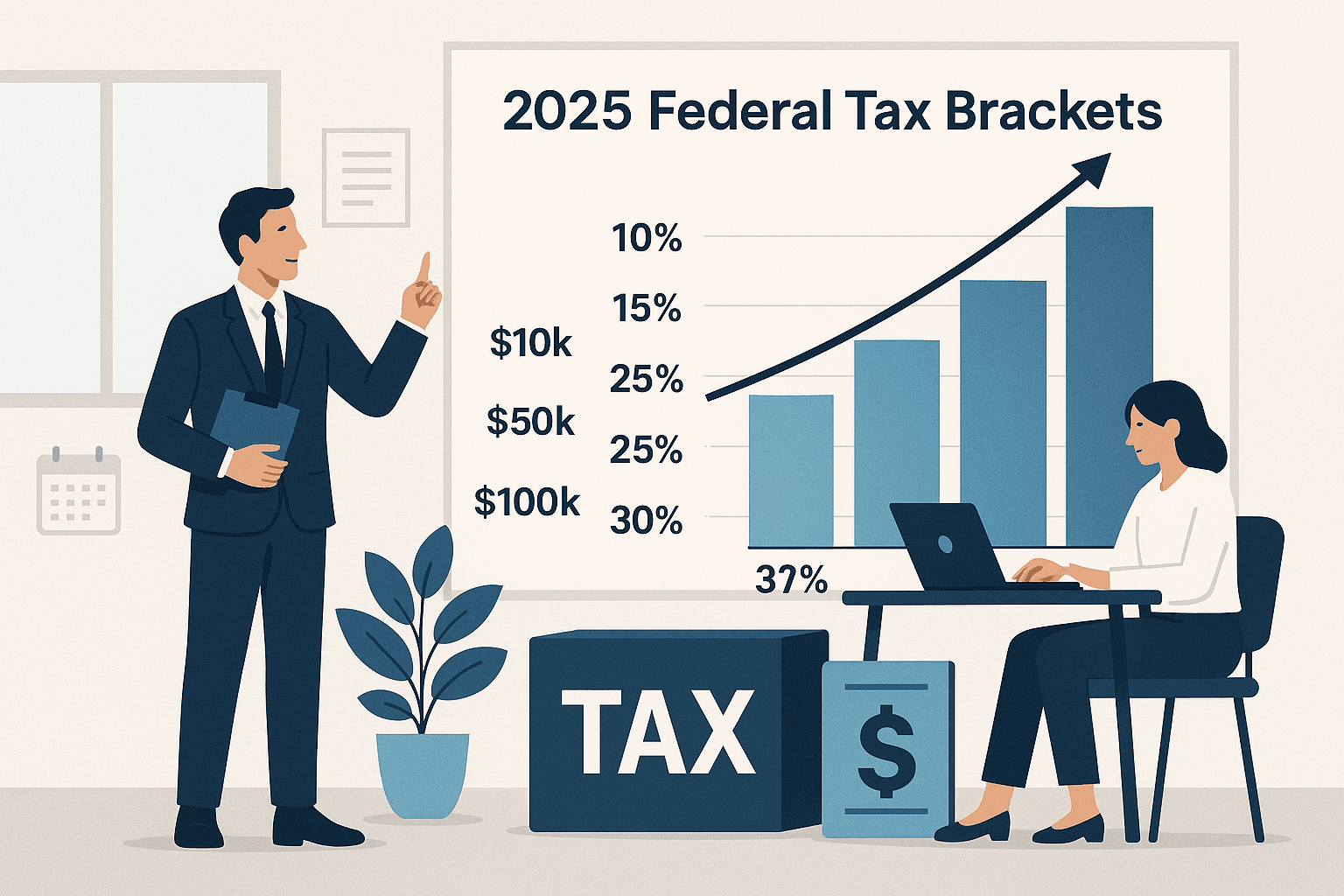
If you have ever worried that a raise could "bump you into a higher bracket" and leave you with less money, you can relax. That is one of the most common tax myths, and understanding how brackets actually work will save you stress every April. Here is a clear breakdown of the 2026 federal tax brackets and what they mean for your money.
The 2026 federal tax brackets, by filing status
These rates apply to income you earn in 2026, which you will file taxes on in early 2027. The numbers come from the IRS inflation adjustments (Revenue Procedure 2025-32).
Single filers
- 10% — $0 to $12,400
- 12% — $12,401 to $50,400
- 22% — $50,401 to $105,700
- 24% — $105,701 to $201,775
- 32% — $201,776 to $256,225
- 35% — $256,226 to $640,600
- 37% — $640,601 and up
Married filing jointly
- 10% — $0 to $24,800
- 12% — $24,801 to $100,800
- 22% — $100,801 to $211,400
- 24% — $211,401 to $403,550
- 32% — $403,551 to $512,450
- 35% — $512,451 to $768,700
- 37% — $768,701 and up
Head of household
- 10% — $0 to $17,700
- 12% — $17,701 to $67,450
- 22% — $67,451 to $105,700
- 24% — $105,701 to $201,775
- 32% — $201,776 to $256,200
- 35% — $256,201 to $640,600
- 37% — $640,601 and up
How tax brackets really work
The single most important thing to understand: these are marginal rates. Each rate only applies to the portion of your income that lands inside that bracket. You do not pay your top rate on every dollar you earn.
Say you are a single filer with $60,000 of taxable income in 2026. You do not pay 22% on the whole $60,000. Instead:
- The first $12,400 is taxed at 10% = $1,240
- The next chunk up to $50,400 is taxed at 12% = $4,560
- The remaining amount up to $60,000 is taxed at 22% = $2,112
Your total tax is about $7,912 — an effective rate of roughly 13%, even though your marginal (top) rate is 22%. So a raise never costs you money overall. Only the new dollars in the higher bracket get taxed at the higher rate.
Marginal vs. effective tax rate
These two terms trip a lot of people up, so here is the plain-English version.
Your marginal rate is the rate on your last dollar earned — the highest bracket your income reaches. It is the number that matters when you are deciding whether extra income, a bonus, or a side gig is worth it.
Your effective rate is the total tax you pay divided by your total income — what you actually hand over as a percentage. It is always lower than your marginal rate because of the lower brackets stacked underneath it.
When someone says "I'm in the 24% bracket," they mean their marginal rate. Their effective rate is usually several points lower.
The 2026 standard deduction lowers your taxable income first
Before any bracket touches your income, you subtract the standard deduction. For 2026 the standard deduction is:
- Single: $16,100
- Married filing jointly: $32,200
- Head of household: $24,150
Taxpayers 65 and older get an additional standard deduction on top of these amounts. Because most people take the standard deduction rather than itemizing, this is the number that shrinks your taxable income before the brackets even start. A single filer earning $50,000 in wages, for example, is only taxed on about $33,900 after the standard deduction.
A few other 2026 numbers worth knowing
- Child Tax Credit: Up to $2,200 per qualifying child, with up to $1,700 refundable.
- Long-term capital gains: Taxed at 0%, 15%, or 20% depending on income — separate from the ordinary brackets above. Many middle-income households pay 0% or 15% on long-term gains.
- Earned Income Tax Credit: Worth up to $664 with no children and up to $8,231 for families with three or more children.
These are the provisions that quietly put real money back in working families' pockets, so it is worth checking which ones you qualify for.
How to use this when planning
A few practical takeaways:
- A raise is always worth taking. Only the income above the bracket line is taxed at the higher rate.
- Know your marginal rate before adding income. If you are considering a bonus or freelance work, your marginal rate tells you what share of those new dollars goes to taxes.
- Watch the bracket edges. Contributing to a traditional 401(k) or HSA can lower your taxable income and may keep more of your money in a lower bracket.
- Standard vs. itemized. Take whichever is larger. For most households, the higher 2026 standard deduction wins.
The bottom line
The 2026 federal tax system keeps the same seven rates — 10% through 37% — with thresholds nudged up for inflation and a higher standard deduction across the board. Brackets are marginal, so your top rate never applies to all your income, and earning more never leaves you worse off. Knowing the difference between your marginal and effective rate is the key to making smart, confident money decisions all year.
This article is educational and not tax advice. Tax situations vary, and figures are based on IRS 2026 inflation adjustments. For guidance on your specific return, consult a qualified tax professional or the IRS directly.
This content is for educational purposes only and does not constitute financial advice. Consult a licensed financial professional for advice specific to your situation.
MoneySimple may receive compensation from partners featured on this page. This does not influence our editorial opinions or recommendations.
Related articles
More guidance you might find helpful.

6 Best Student Credit Cards in 2026: Ranked for Cash Back and Credit Building
Compare six no-annual-fee student credit cards ranked by rewards, approval accessibility, and credit-building features, with tips for first-time cardholders.
Debt Snowball vs. Debt Avalanche: Which Payoff Method Works Faster?
The debt snowball and debt avalanche methods compared on total interest paid, time to debt-free, and real-world completion rates, plus a hybrid approach that blends both.

How Credit Cards Work: A Complete Guide to Interest, Rewards, Fees, and Choosing a Card
A credit card is a revolving line of credit: you borrow from a bank to pay for things, then either repay the full statement balance by the due date and owe no interest, or carry the balance and pay interest on it. Here's how billing cycles, APRs, grace periods, rewards, fees, and credit-score effects actually work — with current 2026 numbers.
Get smarter about money.
Free weekly tips on credit, debt, taxes, and more.
No spam. Unsubscribe anytime.
