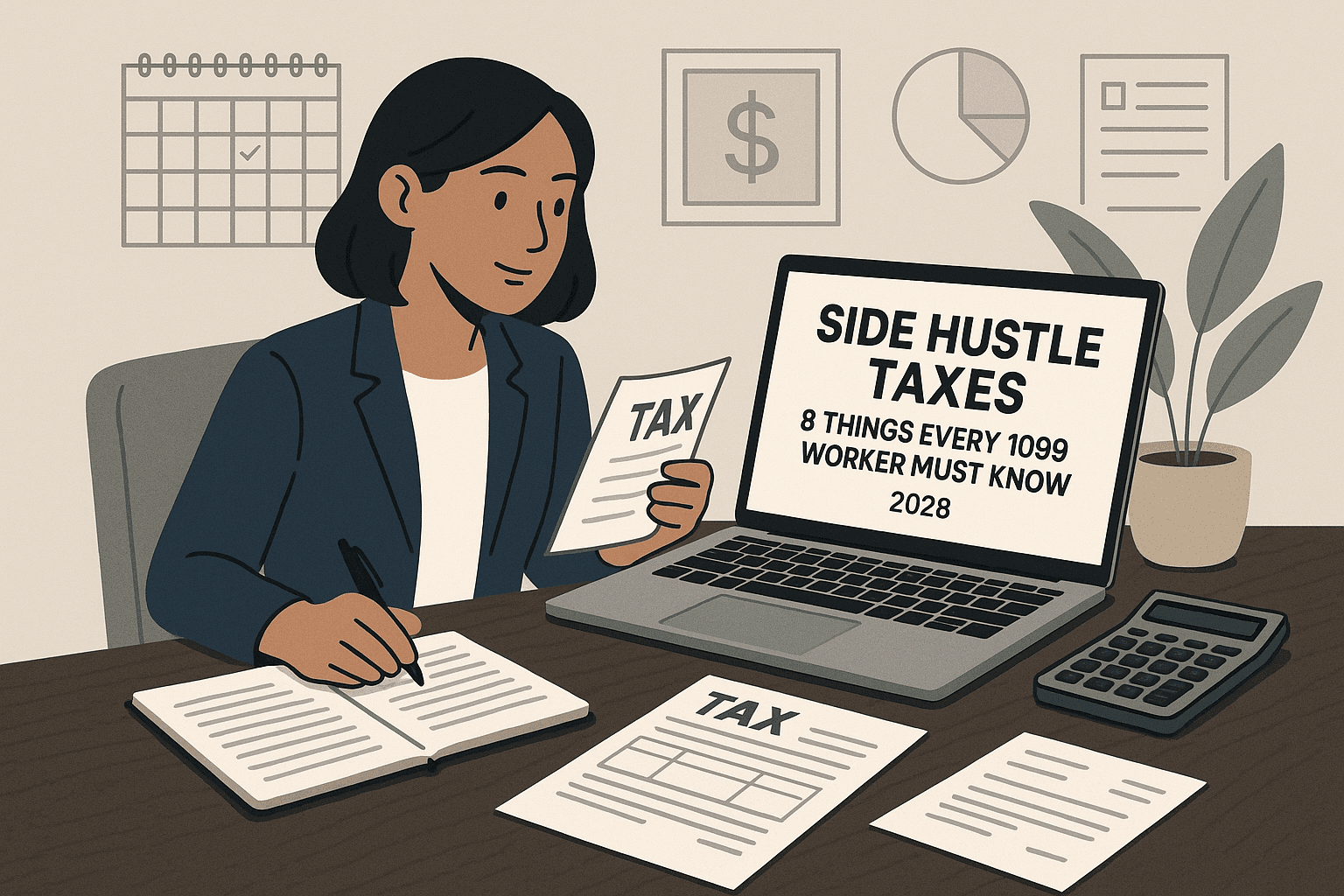
Side Hustle Taxes: 8 Things Every 1099 Worker Must Know in 2026
Earned money from a side hustle? You owe self-employment taxes on income above $400. Here are 8 essential tax rules every 1099 worker must know in 2026 — including quarterly payments, deductions, and ways to reduce your bill.
Last updated: May 2026 | Reviewed by the MoneySimple Editorial Team
If your side hustle earned more than $400 in 2025, you owe self-employment taxes — and possibly estimated quarterly taxes. This guide covers every tax obligation 1099 workers face: what you owe, when you pay it, and which deductions reduce your bill.
How Side Hustle Taxes Work
Self-employed workers pay two layers of tax:
- Income tax — same brackets as W-2 workers (10%–37% depending on total income)
- Self-employment tax — 15.3% on net self-employment income, covering Social Security and Medicare. W-2 workers split this 50/50 with employers; as a self-employed worker, you pay the full 15.3%.
Good news: You deduct half of self-employment tax from your gross income on Schedule 1 of Form 1040, which reduces your income tax bill.
Key Tax Facts at a Glance
| Threshold | Rule |
|---|---|
| $400 net income | Minimum to owe self-employment tax |
| $600+ from one client | Client must send you a 1099-NEC |
| 15.3% | Self-employment tax rate on net income |
| 90% of current year tax | Safe harbor to avoid underpayment penalty |
| April 15, June 16, Sept 15, Jan 15 | 2026 quarterly estimated tax due dates |
8 Things Every 1099 Worker Must Know in 2026
1. You Pay Self-Employment Tax on Top of Income Tax
Your side hustle income doesn't appear on a W-4. No employer withholds taxes. You owe the IRS directly.
Self-employment tax = 15.3% on the first $176,100 of net self-employment income (2026 Social Security wage base), then 2.9% above that. Net income equals gross revenue minus deductible business expenses.
You also deduct 50% of self-employment tax from adjusted gross income — which reduces your income tax bill.
Pros: Half of SE tax is deductible; business expenses reduce the taxable base
Cons: No employer contribution — you fund the full 15.3%
Who this affects most: Gig workers, Etsy sellers, Upwork freelancers, anyone receiving 1099-NEC forms with no employer tax withholding
2. Quarterly Estimated Taxes Are Not Optional
If you expect to owe $1,000 or more after credits and withholding, the IRS requires quarterly estimated payments. Missing them means a penalty — even if you pay everything by April 15.
2026 due dates:
- Q1 (Jan 1–Mar 31): April 15, 2026
- Q2 (Apr 1–May 31): June 16, 2026
- Q3 (Jun 1–Aug 31): Sept 15, 2026
- Q4 (Sep 1–Dec 31): Jan 15, 2027
Pay via IRS Direct Pay (irs.gov/payments) or EFTPS. Each payment takes 5 minutes online.
Safe harbor rule: Pay at least 100% of last year's total tax liability (110% if AGI exceeded $150,000) and you avoid underpayment penalties — even if you end up owing more at filing.
Pros: Avoids surprise April bill and underpayment penalties
Cons: Requires cash flow planning throughout the year
Who this is best for: All self-employed workers with variable income
3. Every Business Expense Reduces Your Taxable Income
Self-employed workers deduct ordinary and necessary business expenses from revenue before calculating self-employment tax. This is more powerful than an itemized deduction — it reduces both income tax AND self-employment tax.
| Expense | Deductible? |
|---|---|
| Home office (dedicated space only) | Yes — simplified or actual method |
| Business phone/internet | Yes — business-use percentage only |
| Equipment & supplies | Yes |
| Vehicle mileage (business trips) | Yes — $0.70/mile standard rate (2026) |
| Software subscriptions | Yes — business-use only |
| Professional development | Yes |
| Business meals | Yes — 50% deductible |
| Health insurance premiums | Yes — deductible on Schedule 1 |
Keep receipts and records. Schedule C filers face higher audit rates than W-2 workers.
4. The Home Office Deduction Is Real — But Has Rules
You can deduct home office expenses if you use a portion of your home regularly and exclusively for business. The IRS offers two methods:
- Simplified method: $5 per square foot, up to 300 sq ft ($1,500 max deduction)
- Actual expenses method: Deduct the home-use percentage of rent, mortgage interest, utilities, and insurance
Pros: Legitimate deduction that most freelancers qualify for
Cons: "Exclusive use" is strict — a desk in a shared bedroom doesn't qualify
Who this is best for: Freelancers with a dedicated room or defined workspace
Who should avoid: Workers using a dual-purpose room for both business and personal use
5. Track Every Business Mile You Drive
The 2026 IRS standard mileage rate is $0.70 per mile for business driving. Every mile to a client, job site, supply store, or business meeting is deductible.
A freelancer driving 5,000 business miles deducts $3,500 from taxable income with no additional paperwork beyond a mileage log.
Use apps like MileIQ or Everlance to auto-track trips. The IRS requires a contemporaneous log — records made long after the fact are more likely to be disallowed in an audit.
Pros: Large deduction with minimal effort if tracked consistently
Cons: Log must be kept in real time, not reconstructed at tax time
Who this is best for: Delivery drivers, contractors visiting client sites, mobile service providers
6. Retirement Contributions Cut Your Tax Bill Significantly
Self-employed workers can contribute to a SEP-IRA (up to 25% of net self-employment income, max $70,000 in 2026) or a Solo 401(k). Both reduce taxable income dollar-for-dollar.
A freelancer earning $60,000 net who contributes $12,000 to a SEP-IRA reduces taxable income to $48,000 — saving roughly $2,900 in federal income tax plus lowering the self-employment tax base.
Deadline: SEP-IRA contributions for 2025 can be made until your tax filing deadline, including extensions (October 2026 with an extension).
Pros: Saves for retirement while reducing current-year taxes
Cons: Money is locked until age 59½ without early withdrawal penalties
Who this is best for: Side hustlers with consistently profitable income who want to build long-term wealth
7. Keep Business and Personal Finances Separate
Mixing personal and business transactions is the most common mistake new side hustlers make. It creates audit risk and turns expense tracking into a nightmare at tax time.
Open a dedicated business checking account — most online banks offer free business accounts. Pay all business expenses from that account and receive all client payments into it. This creates a clean paper trail and protects your deductions.
Pros: Clean records; dramatically easier tax prep
Cons: Small setup time upfront; requires discipline
Who this is best for: Anyone running a side hustle with recurring income and expenses
8. Know When to Hire a Tax Professional
DIY tax software handles simple side hustle income well. Hire a CPA or enrolled agent when:
- You earned $50,000+ from self-employment
- You have employees or contractors of your own
- You're claiming home office plus vehicle deductions
- You missed estimated payments and face penalties
- You have multi-state income or conflicting 1099s
A CPA typically charges $200–$500 for a Schedule C return and often saves more than their fee in deductions most software misses.
Side Hustle Tax Checklist
- Track all income — every client payment, PayPal transfer, gig platform payout
- Collect all 1099-NEC forms from clients who paid you $600+
- Log business expenses monthly (not at tax time)
- Track business mileage with an app throughout the year
- Pay quarterly estimated taxes by each due date
- Contribute to a SEP-IRA or Solo 401(k) to reduce taxable income
- File Schedule C (Form 1040) reporting net profit or loss
- Pay self-employment tax via Schedule SE
Frequently Asked Questions
Do I need to file taxes if my side hustle made only $500?
Yes. Self-employment tax applies on net earnings above $400. You file Schedule C and Schedule SE alongside your regular Form 1040.
What happens if I skip quarterly taxes?
The IRS charges an underpayment penalty — typically 5–6% annually on the amount unpaid. The penalty applies quarter-by-quarter, so even paying everything by April 15 doesn't eliminate it for earlier quarters.
Can I deduct my cell phone for my side hustle?
Yes — the business-use percentage. If you use your phone 40% for business, 40% of the monthly bill is deductible. Document how you calculated the percentage.
What is the difference between a 1099-NEC and 1099-K?
1099-NEC reports non-employee compensation from clients (freelance work). 1099-K reports payment card and third-party network transactions (PayPal, Venmo, Stripe, Etsy). Both are taxable. For 2025 taxes, the 1099-K threshold is $5,000.
Should I form an LLC for my side hustle?
An LLC provides liability protection but doesn't change how you're taxed by default — single-member LLCs file Schedule C the same as sole proprietors. An S-corp election may reduce self-employment tax when income exceeds ~$60,000; consult a CPA first.
How do I pay estimated taxes?
Use IRS Direct Pay at irs.gov/payments. It's free, instant, and requires no registration. Pay from any bank account in about 5 minutes.
What records should I keep and for how long?
Keep all business income records, receipts, and mileage logs for at least 3 years from the filing date. Keep records related to property or assets for 7 years.
Can I deduct health insurance as a self-employed worker?
Yes. Self-employed health insurance premiums (for yourself, spouse, and dependents) are deductible on Schedule 1, Line 17 — not Schedule C. This reduces your income tax but not self-employment tax.
This article is for informational purposes only and does not constitute tax or legal advice. Tax laws change frequently — always verify current rates and limits with the IRS or a qualified tax professional. Consult a CPA for advice specific to your situation.
Last updated: May 2026. Reviewed annually.
Author: MoneySimple Editorial Team | Personal finance specialists covering taxes, savings, and budgeting for everyday Americans.
This content is for educational purposes only and does not constitute financial advice. Consult a licensed financial professional for advice specific to your situation.
MoneySimple may receive compensation from partners featured on this page. This does not influence our editorial opinions or recommendations.
Related articles
More guidance you might find helpful.

Best Nonprofit Credit Counseling Agencies 2026: 7 Compared
Compare 7 nonprofit credit counseling agencies for 2026 on fees, accreditation and services, plus how debt management plans work.

Debt Consolidation Loan vs Balance Transfer: Which Saves More Money in 2026
A balance transfer usually saves more if you can pay off the debt in 18–21 months. A consolidation loan wins for larger balances. Here is how the options compare on cost, speed, and risk.

Best Gas and Grocery Rewards Credit Cards 2026: 6 Cards Compared
Compare six gas and grocery rewards credit cards on earn rates, caps, fees, and real yearly rewards. See which card earns the most for a typical household in 2026.
Get smarter about money.
Free weekly tips on credit, debt, taxes, and more.
No spam. Unsubscribe anytime.
