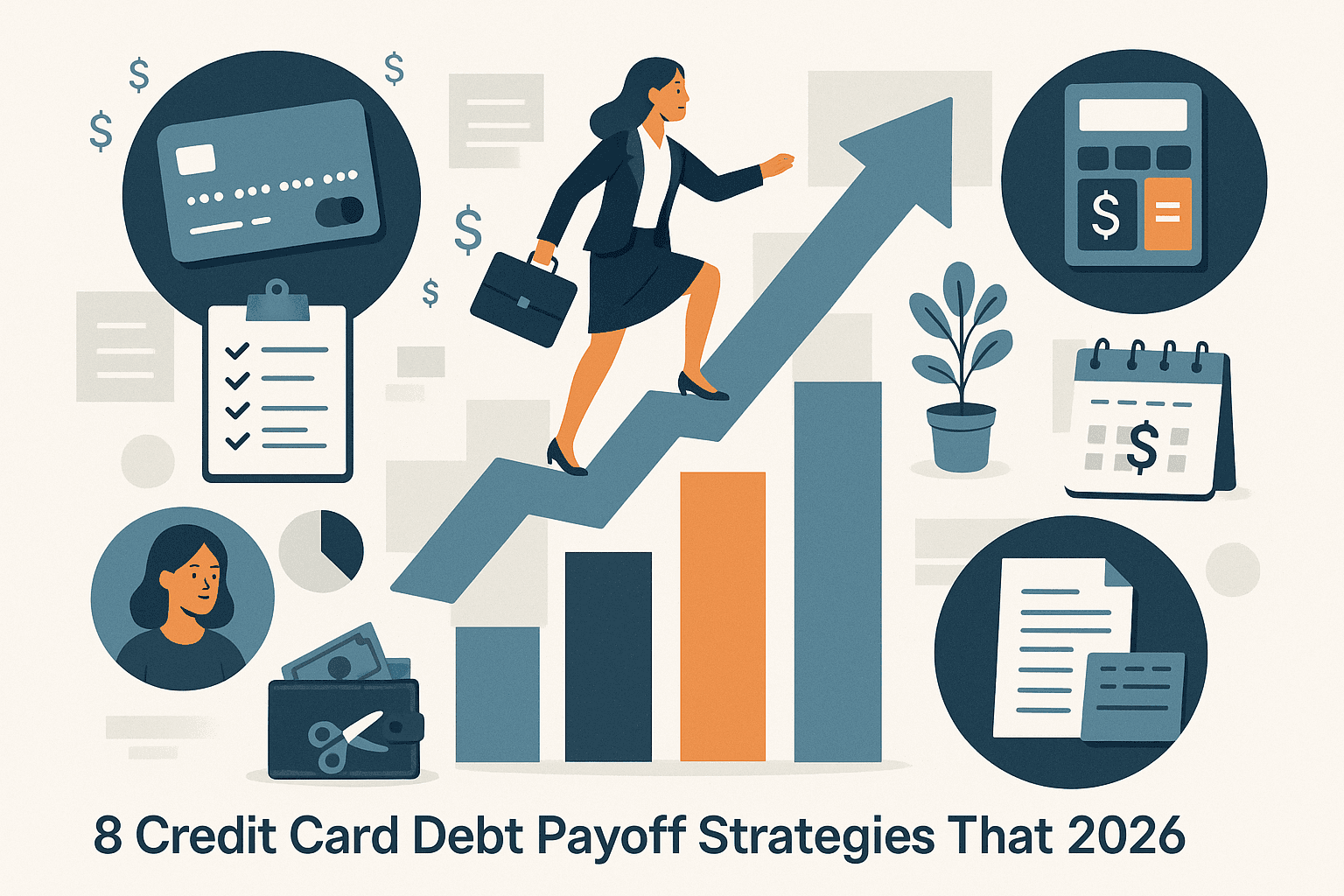
8 Credit Card Debt Payoff Strategies That Actually Work in 2026
American credit card debt hit $1.17 trillion in 2025. Here are 8 proven strategies — from the debt avalanche to balance transfers to nonprofit debt management plans — to pay it off faster.
Updated April 2026 · Reviewed by the MoneySimple Editorial Team · Category: Debt Management
The short answer: The best strategy to pay off credit card debt depends on your credit score, total balance, and monthly cash flow. For most people, the debt avalanche method saves the most in interest. A 0% balance transfer card works best if your credit score is above 670. If you owe more than $10,000 and feel overwhelmed, a nonprofit debt management plan provides structure and creditor negotiation.
American credit card debt hit $1.17 trillion in 2025 — a record high. With average interest rates above 20%, carrying a balance is expensive: a $5,000 balance at 24% APR costs roughly $1,200 a year in interest if you're only making minimum payments.
The good news: there's a clear path out for almost everyone. The right strategy depends on your credit score, how much you owe, and how much you can put toward debt each month.
Here are 8 credit card debt payoff strategies ranked from lowest-cost to most impactful for high-debt situations.
Quick Comparison: Which Strategy Is Right for You?
| Strategy | Best For | Cost | Credit Score Impact | Time to Payoff |
|---|---|---|---|---|
| Debt Avalanche | Disciplined payers, multiple cards | Free | Positive | 1–5 years |
| Debt Snowball | Motivation-driven payers | Free | Positive | 1–5 years |
| Balance Transfer | Good credit (670+), under $15K | 3–5% fee | Slight initial dip | 12–21 months |
| Debt Consolidation Loan | Multiple cards, steady income | Origination fee | Slight initial dip | 2–5 years |
| Creditor Hardship Plan | Temporary financial difficulty | Free | May lower limit | 6–24 months |
| Debt Management Plan | Overwhelmed, need structure | $25–$55/mo | Neutral to positive | 3–5 years |
| Debt Settlement | Can't afford full repayment | 15–25% of settled debt | Significant negative | 2–4 years |
| Bankruptcy | All other options exhausted | Filing fees + attorney | Severe, 7–10 years | Immediate discharge |
1. Debt Avalanche Method
What it is: Pay minimums on all cards except the one with the highest interest rate. Put every extra dollar toward that highest-rate card. Once it's paid off, redirect everything to the next highest rate.
Why it works: Interest is your real obstacle. The avalanche method eliminates your most expensive debt first, so you pay less total interest over time. Mathematically, this is the optimal strategy.
Example: You have three cards:
- Card A: $3,000 balance, 28% APR
- Card B: $5,000 balance, 22% APR
- Card C: $1,500 balance, 18% APR
Pay minimums on B and C. Put everything extra toward Card A. Once Card A is gone, roll all of that payment into Card B, then C.
Who it's best for: Anyone with steady income who can stay motivated even when early progress feels slow.
Potential drawback: If your highest-rate card also has a large balance, it may take months before you see a card fully paid off. If motivation is the challenge, consider starting with the snowball method instead.
2. Debt Snowball Method
What it is: Pay off your smallest balance first — regardless of interest rate — then roll that payment toward the next smallest balance.
Why it works: Psychology matters in debt payoff. Every card you eliminate is a tangible win. That momentum keeps you going through the harder work ahead.
Research backing: Studies on debt payoff behavior have found that focusing on eliminating individual accounts increases the likelihood of becoming debt-free compared to strategies that focus purely on reducing total balance.
Who it's best for: People who've struggled to stick with debt payoff plans before, or anyone who needs early visible wins to stay motivated.
The honest tradeoff: You'll likely pay more in total interest compared to the avalanche method. The payoff is motivation and follow-through — which matters more than optimal math if the math-first approach hasn't worked for you.
3. Balance Transfer to a 0% APR Card
What it is: Move your existing credit card balances to a new card offering 0% interest for an introductory period — typically 12 to 21 months.
Why it works: Every dollar you pay during the 0% period goes entirely to principal. No interest eating into your progress each month.
What to know before you apply:
- Most balance transfer cards charge a 3–5% fee on the amount transferred
- You'll generally need a credit score of 670 or higher to qualify
- If you don't pay off the balance before the intro period ends, remaining balances revert to the card's standard APR (often 20–29%)
- Don't add new purchases to the balance transfer card — this slows your payoff
Example: Moving $5,000 to a card with a 5% transfer fee costs $250 upfront. But at 0% for 18 months, $278/month eliminates the full balance. At 24% APR with minimum payments, you'd still owe thousands three years later.
Who it's best for: People with a credit score of 670+ and a total balance under $15,000 who can commit to paying it off during the intro period.
→ See our picks for the best balance transfer credit cards in 2026
4. Debt Consolidation Loan
What it is: Take out a personal loan at a lower interest rate than your credit cards, use it to pay off all your cards, then repay the single loan with one fixed monthly payment.
Why it works: Simplification plus potential savings. Credit card APRs average 20%+ right now. Personal loans for qualified borrowers often run 10–18%. That gap can save you significant money in interest over a 2–5 year term.
What to know:
- Your rate depends heavily on your credit score — higher scores get lower rates
- Look for loans with no prepayment penalty so you can pay extra when possible
- The biggest risk: using your cards again after paying them off, leaving you with both the loan and new card debt
Who it's best for: People with multiple cards, a credit score above 640, and steady income who want one predictable monthly payment.
Who should be cautious: If your credit score is below 620, you may not qualify for a rate low enough to make consolidation worthwhile. Run the math on your actual rate offer before signing.
→ Best debt consolidation loans for bad credit in 2026 | → Best personal loans for bad credit in 2026
5. Creditor Hardship Plans
What it is: Call your credit card company directly and ask for a hardship or workout plan. Many issuers have internal programs that temporarily lower your interest rate, waive fees, or reduce minimum payments.
Why it works: Card issuers don't want you to default — a hardship plan costs them less than a charge-off. Most people never ask, but most issuers will work with you if you do.
What to say: "I'm going through a financial hardship and need help managing my payments. Can you tell me what hardship assistance options are available?"
What to expect:
- Temporary interest rate reduction (often to 0–9.99% for 6–12 months)
- Waived late fees or over-limit fees
- Reduced minimum payment
- Your card may be closed or frozen during the plan
Who it's best for: People experiencing temporary hardship — job loss, medical bills, income reduction — who need short-term breathing room.
Important: Programs vary significantly by issuer. Call the number on the back of your card and ask specifically about hardship or financial assistance programs.
6. Nonprofit Credit Counseling / Debt Management Plan (DMP)
What it is: A nonprofit credit counseling agency reviews your finances, negotiates with creditors on your behalf, and sets up a Debt Management Plan. You make one monthly payment to the agency, which distributes it to your creditors.
What they negotiate for you:
- Reduced interest rates — often to 6–9% across all enrolled accounts
- Waived late and over-limit fees
- A structured 3–5 year payoff timeline
What it costs: Monthly fees of $25–$55 through a nonprofit agency. Avoid for-profit "debt relief" companies that charge significantly more and often deliver less.
How to find a legitimate agency: Look for NFCC (National Foundation for Credit Counseling) member agencies at nfcc.org. Initial consultations are typically free.
Who it's best for: People with $10,000 or more in unsecured debt who feel overwhelmed managing multiple creditors and want a structured plan with professional support.
Credit impact: Cards enrolled in a DMP are typically closed, which may temporarily affect your score. Consistent on-time payments throughout the plan generally improve your score over the 3–5 year term.
7. Debt Settlement
What it is: Negotiate with creditors to accept a lump-sum payment less than what you owe — typically 40–60 cents on the dollar.
The real cost:
- Settled debt above $600 is generally taxable as income (the forgiven amount counts as income to the IRS)
- Your credit score will take a severe hit — expect significant drops that last years
- Accounts typically must be 90+ days delinquent before creditors will negotiate
- For-profit debt settlement companies charge 15–25% of enrolled debt in fees
- Not all creditors will settle; some pursue legal action for the full amount
Who it may be right for: People who genuinely cannot afford full repayment and want to avoid bankruptcy. This is a serious financial decision with lasting consequences — consult a nonprofit credit counselor before choosing this path.
Who should avoid it: Anyone who can realistically qualify for a DMP or consolidation loan. The credit damage and tax implications make settlement a last-resort option.
8. Bankruptcy
What it is: A federal legal process that either discharges unsecured debt (Chapter 7) or restructures it into a 3–5 year repayment plan (Chapter 13).
Chapter 7: Most credit card debt is eliminated. The process takes 3–6 months. You must pass a means test based on income. Stays on your credit report for 10 years.
Chapter 13: You repay a portion of debt over 3–5 years based on income. Lets you keep assets you might lose in Chapter 7. Stays on credit report for 7 years.
When it makes sense:
- Debt is so large relative to income that no other strategy is realistic
- Creditors are pursuing wage garnishment or lawsuits
- You need the automatic stay — the legal halt on all collection activity
What to know: Bankruptcy is a legal tool designed to give people a genuine second start. Consult a nonprofit credit counselor first to explore all alternatives. If you proceed, work with a licensed bankruptcy attorney — not a document preparer or petition service.
How to Choose: A Simple Decision Framework
Can you pay more than the minimums? → Start with the avalanche or snowball method. Free. No credit impact.
Credit score 670 or above? → Check 0% balance transfer cards. You can eliminate interest entirely for 12–21 months.
Multiple high-rate cards and steady income? → A debt consolidation loan simplifies payments and may lower your rate.
Temporary hardship? → Call your card issuers. Ask specifically about hardship assistance. Most people never ask — most issuers will help.
More than $10,000 in debt and feeling overwhelmed? → A nonprofit debt management plan provides structure, creditor negotiation, and accountability.
Can't realistically afford full repayment? → Debt settlement is an option with significant tradeoffs. Talk to a nonprofit counselor first.
Debt is crushing your financial life and no other path is viable? → Bankruptcy provides legal protection and a real fresh start. Consult a licensed attorney.
Frequently Asked Questions
What is the fastest way to pay off credit card debt?
The fastest path depends on your credit profile. For people with a credit score of 670 or above, a 0% balance transfer card lets every payment go toward principal during the introductory period — often 12 to 21 months. For those without access to a balance transfer, the debt avalanche method eliminates your highest-rate debt first, reducing the total interest that slows your progress.
Does paying off credit card debt improve your credit score?
Yes, in most cases. Reducing your credit utilization ratio — how much of your available credit you're using — is one of the fastest ways to improve your credit score. Paying balances below 30% of your credit limit, and ideally below 10%, typically produces a noticeable score increase within 30 to 60 days.
Is debt consolidation a good idea?
Debt consolidation can be a smart move if you qualify for a lower interest rate than what your current cards charge. It simplifies multiple payments into one and often reduces total interest paid. The primary risk is using your credit cards again after consolidating, which leaves you with both the loan payment and new card debt.
What credit score do I need for a balance transfer card?
Most balance transfer cards require a credit score of 670 or above. Some premium cards require 720 or higher. If your score is below 670, focus on the avalanche or snowball method while working to improve your score, then revisit a balance transfer once you qualify.
How does a debt management plan affect my credit?
The DMP itself doesn't directly harm your credit. However, creditors typically require enrolled accounts to be closed, which may lower your score temporarily by reducing available credit. Consistent on-time payments throughout the 3–5 year program generally improve your score over time.
This article is for educational purposes and does not constitute financial or legal advice. Individual results vary based on your specific financial situation. If you're struggling with debt, consider speaking with a nonprofit credit counselor through the NFCC (nfcc.org) — initial consultations are typically free.
Related Reading:
- Best Debt Consolidation Loans for Bad Credit in 2026
- 7 Best Balance Transfer Credit Cards in 2026
- 7 Best Personal Loans for Bad Credit in 2026
- 5 Best Secured Credit Cards for Rebuilding Credit in 2026
Credit & Debt Library
- 7 Best Balance Transfer Credit Cards in 2026 (0% APR Up to 21 Months)
- Best Debt Consolidation Loans for Bad Credit in 2026
- How to Get Out of Debt: The Complete Step-by-Step Guide
- 5 Best Secured Credit Cards for Rebuilding Credit in 2026
- 6 Small Business Tax Credits You Shouldn't Miss in 2026 (Worth $15K+ Annually)
- 7 Best Balance Transfer Credit Cards of 2026
- 7 Best Credit Score Monitoring Apps of 2026
- 7 Best Debt Consolidation Companies of 2026: Ranked by Real Borrower Outcomes
- 7 Best Personal Loans for Bad Credit in 2026
- 7 Debt Payoff Strategies Ranked: Which Method Saves the Most Money in 2026
- 7 Hidden Ways Your Credit Score Is Costing You $100K Over a Lifetime
- 9 Debt Payoff Methods That Actually Work — Find the Right One for Your Situation
- Best Cash Back Credit Cards of 2026: 7 Top Picks Compared
- Best Cash Back Credit Cards of 2026: Top Picks Ranked by Spending Category
- Best Credit Monitoring Services of 2026: Top Picks Compared
- Best Credit Repair Companies of 2026 (Reviewed and Compared)
- Best Credit Unions of 2026: 8 Top Picks Compared
- Best Debt Settlement Companies 2026
- Best No Annual Fee Credit Cards in 2026: 7 Top Picks Compared
- Best Personal Loans for Debt Consolidation in 2026: 7 Lenders Compared
- Best Rent Reporting Services to Build Credit in 2026
- Best Small Business Credit Cards in 2026: 8 Top Cards Compared
- Best Travel Rewards Credit Cards in 2026
- Best Travel Rewards Credit Cards of 2026 (Ranked by Points Value)
- How to Build Credit in 2026: 9 Proven Strategies Ranked by Speed and Impact
- How to Consolidate Debt in 2026: 6 Methods Compared (+ How to Run the Numbers)
- The 5 Best Debt Payoff Apps of 2026, Ranked and Compared
- The Bankruptcy Protection Playbook: 7 Alternatives Creditors Don't Want You Knowing
This content is for educational purposes only and does not constitute financial advice. Consult a licensed financial professional for advice specific to your situation.
MoneySimple may receive compensation from partners featured on this page. This does not influence our editorial opinions or recommendations.
Related articles
More guidance you might find helpful.
6 Best Student Credit Cards in 2026: Ranked for Cash Back and Credit Building
Compare six no-annual-fee student credit cards ranked by rewards, approval accessibility, and credit-building features, with tips for first-time cardholders.
Debt Snowball vs. Debt Avalanche: Which Payoff Method Works Faster?
The debt snowball and debt avalanche methods compared on total interest paid, time to debt-free, and real-world completion rates, plus a hybrid approach that blends both.
How Credit Cards Work: A Complete Guide to Interest, Rewards, Fees, and Choosing a Card
A credit card is a revolving line of credit: you borrow from a bank to pay for things, then either repay the full statement balance by the due date and owe no interest, or carry the balance and pay interest on it. Here's how billing cycles, APRs, grace periods, rewards, fees, and credit-score effects actually work — with current 2026 numbers.
Get smarter about money.
Free weekly tips on credit, debt, taxes, and more.
No spam. Unsubscribe anytime.
