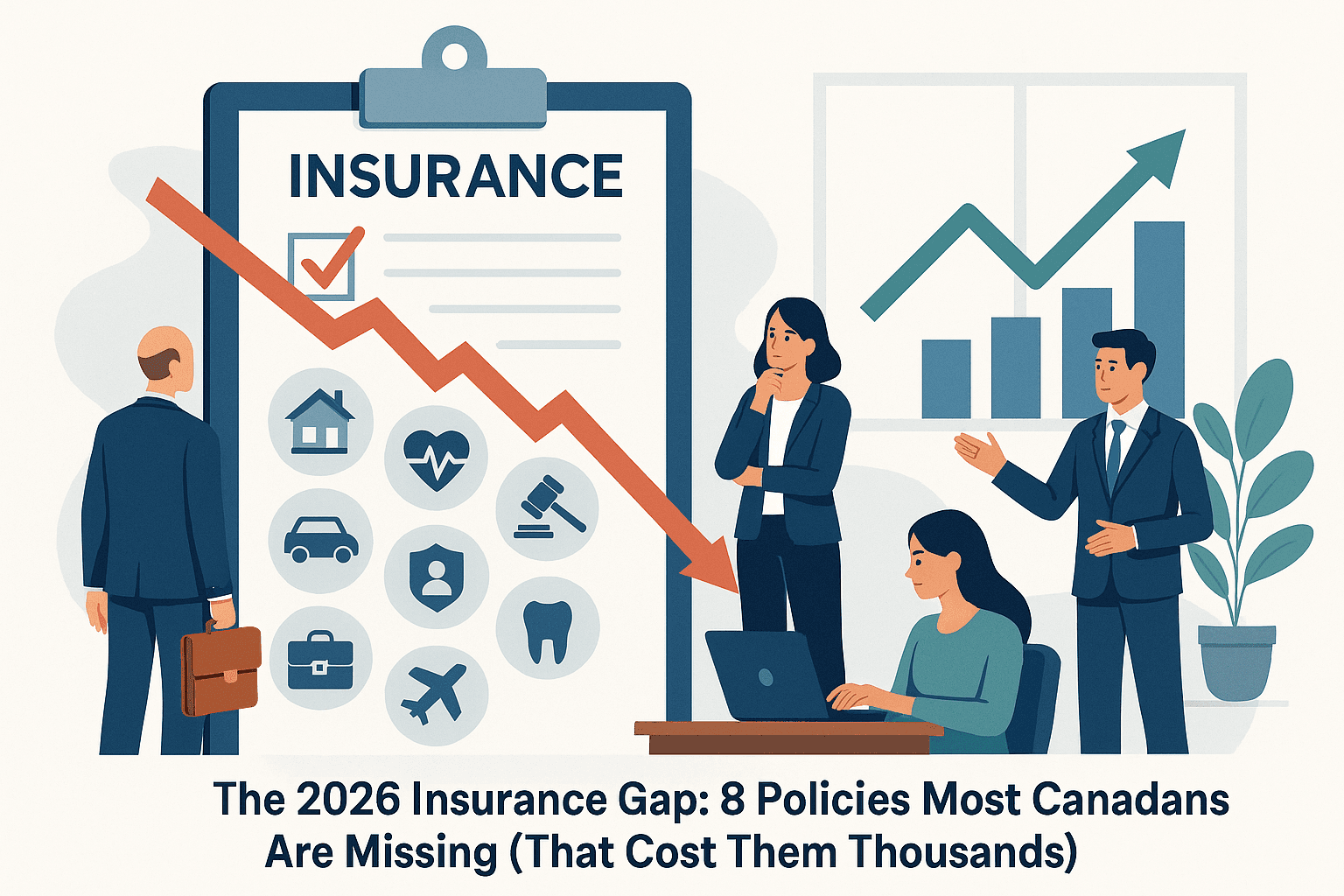
The 2026 Insurance Gap: 8 Policies Most Canadians Are Missing (That Cost Them Thousands)
Most Canadians are significantly underinsured and do not know it until a claim is denied. We identified the 8 most expensive insurance coverage gaps Canadian households are missing in 2026, ranked by financial impact, with cost data to fix each one.
Most Canadians are significantly underinsured — (learn more about 9 debt payoff methods that actually work — find the right one for your situation) (learn more about 10 tax deductions you shouldn't miss in 2026 (including 4 brand-new ones)) (learn more about 8 credit card debt payoff strategies that actually work in 2026) (learn more about 7 best balance transfer credit cards in 2026 (0% apr up to 21 months)) (learn more about 7 student loan forgiveness programs in 2026: are you eligible?) (learn more about roth ira conversion strategy 2026: 7 steps to tax-free retirement income) and they do not know it until a claim is denied. The most expensive gaps are disability insurance (only 31% of Canadian workers have adequate coverage), critical illness insurance, and mortgage life insurance sold at the bank (which typically pays the lender, not your family). We identified 8 policies that surveys from LIMRA and the Canadian Life and Health Insurance Association consistently show are missing or inadequate in most Canadian households, ranked by financial impact. This guide explains what each gap costs, who it affects most, and how to fix it affordably.
How We Identified These Gaps
We evaluated each insurance gap across 4 criteria:
| Criteria | Weight | Why It Matters |
|---|---|---|
| Financial Impact | High | What does an uninsured event actually cost? |
| Coverage Prevalence | High | How many Canadians are missing this? |
| Replaceability | Medium | Can lost income/assets be replaced without insurance? |
| Affordability to Fix | Medium | How expensive is this coverage to add? |
Data sources: LIMRA Canadian Insurance Barometer, Canadian Life and Health Insurance Association (CLHIA) annual reports, Insurance Bureau of Canada (IBC), Statistics Canada, and Sun Life Financial consumer surveys.
1. Long-Term Disability Insurance — The $1.4 Million Gap
Best for: Any working Canadian who relies on their income
Who's missing it: Approximately 69% of Canadian workers lack adequate long-term disability coverage
Financial impact: Catastrophic — average long-term disability claim lasts 2.6 years
Long-term disability (LTD) insurance replaces 60–85% of your income if you cannot work due to illness or injury. CLHIA data shows disability is the leading cause of mortgage default in Canada — yet most Canadians either have no LTD coverage or rely on group benefits that expire after 2 years. Statistics Canada reports the average household savings rate cannot sustain more than 3–4 months of income loss. Individual LTD policies run $75–$200/month depending on occupation, benefit period, and elimination period. This is the most financially dangerous insurance gap on this list. If you are also building an emergency fund alongside insurance, a high-yield savings account is where that buffer belongs.
Pros of Adding LTD Coverage
- Replaces the majority of your income if you cannot work
- Individual policies are portable — they move with you when you change employers
- Own-occupation definitions protect specialists at their specific role
Cons / Watch-Outs
- Group LTD through employers often has an "any occupation" definition after 2 years — much harder to qualify for
- Waiting periods (90–120 days) mean you need short-term savings as a bridge
- Pre-existing conditions may be excluded or rated
Who This Is Best For
Anyone whose household depends on their employment income — particularly self-employed Canadians and those in group plans with "any occupation" definitions after the first two years. Coverage is especially critical for people aged 30–55 whose earning years are most at risk.
2. Critical Illness Insurance — Surviving the Diagnosis Is Not Enough
Best for: Working Canadians who could not sustain a major illness without financial strain
Who's missing it: 73% of Canadians have no critical illness coverage (CLHIA)
Financial impact: Average out-of-pocket cost after a cancer diagnosis in Canada: $33,000–$75,000
Critical illness insurance pays a tax-free lump sum if you are diagnosed with a covered condition — cancer, heart attack, stroke, and 20+ others depending on the policy. Unlike disability insurance, you receive the payment regardless of whether you can work, and you can spend it on anything: private care, experimental treatment, mortgage payments, or time off. The average CI claim in Canada is approximately $75,000. Monthly premiums for $100,000 of CI coverage run $50–$150 for healthy applicants in their 30s and 40s.
Pros of Adding CI Coverage
- Tax-free lump sum — no restrictions on use
- Covers treatments not included in provincial health plans (private rooms, experimental drugs, travel for care)
- Can fund income replacement during recovery on top of disability benefits
Cons / Watch-Outs
- Survival period clauses (usually 30 days post-diagnosis) mean you must survive before the benefit is paid
- Premiums increase significantly with age — best to buy young
- Some policies cover only 4–5 conditions; look for comprehensive coverage (25+ conditions)
Who This Is Best For
Canadians aged 30–60 who have dependents, a mortgage, or a business. If a cancer or heart attack diagnosis would trigger financial stress on top of health stress, CI insurance is a direct solution. Return-of-premium options exist for those who want a refund if they never claim.
3. Mortgage Life Insurance (Bank-Sold) vs. Individual Term Life — The Policy That Protects the Bank, Not Your Family
Best for: Anyone who bought mortgage life insurance at their bank closing
Who has the wrong product: Estimated 4.2 million Canadian mortgage holders (IBC)
Financial impact: Potentially hundreds of thousands in lost coverage at claim time
Bank-sold mortgage life insurance is a common but poorly understood product. The payout goes directly to the bank to pay off your mortgage — not to your family. Coverage declines as your mortgage balance decreases, but premiums stay the same. There is no medical underwriting at purchase (post-claim underwriting means your claim can be denied after death). An individual term life insurance policy for the same coverage typically costs 30–50% less and pays your beneficiary directly. For most Canadians with a mortgage, replacing bank mortgage life with a term policy is one of the clearest financial wins available.
Pros of Individual Term Life (vs. Bank Mortgage Life)
- Pays your beneficiaries directly — they decide how to use the funds
- Level coverage throughout the term — does not shrink as you pay down the mortgage
- Fully underwritten upfront — no post-claim surprises
Cons / Watch-Outs
- Requires medical underwriting — applicants with health issues may not qualify for preferred rates
- Must actively cancel bank policy after switching
- Term life does not build cash value — purely protection
Who This Is Best For
Any Canadian who currently has mortgage life insurance purchased through their bank or lender. A comparison quote typically takes under 30 minutes and the savings can be substantial. If you have a $500,000 mortgage, you may be paying $150–$200/month for declining bank coverage vs. $40–$60/month for level individual term coverage.
4. Travel Medical Insurance for Snowbirds and Frequent Travelers
Best for: Canadians traveling outside Canada for more than 30 days, especially retirees
Who's missing it: Roughly 40% of Canadian snowbirds travel without adequate medical coverage (CAA survey)
Financial impact: A single U.S. hospital stay averages USD $10,000–$30,000 per day
Provincial health plans provide minimal coverage outside Canada — OHIP, for example, covers just $400 CAD per day for out-of-country emergency hospital stays, when actual U.S. costs are 25–75x that amount. Single-trip travel medical insurance for a 30-day U.S. trip runs $100–$350 for healthy retirees under 65. Annual multi-trip plans start at $250–$600. This is one of the most affordable gaps to close relative to the financial risk involved.
Pros of Travel Medical Coverage
- Prevents catastrophic out-of-pocket costs from U.S. medical emergencies
- Emergency evacuation coverage included in most policies
- Annual plans are more cost-effective for travelers making multiple trips per year
Cons / Watch-Outs
- Pre-existing condition exclusions can be broad — disclose everything accurately at application
- Stability clauses require conditions to be stable for 90–180 days before departure
- Some employer retiree plans include limited travel coverage — check existing policy before buying separately
Who This Is Best For
Any Canadian who travels outside Canada, particularly retirees or snowbirds spending extended time in the U.S. or Mexico. This is the highest-urgency gap for Canadians over 65 who are unaware of how little provincial coverage applies beyond the border.
5. Life Insurance for Stay-at-Home Spouses — The $50,000/Year Gap Nobody Insures
Best for: Households where one partner manages the home and children
Who's missing it: Estimated 2.1 million Canadian households (CLHIA)
Financial impact: Replacement cost of unpaid household labor: $35,000–$60,000/year
The economic contribution of a stay-at-home spouse — childcare, household management, elder care — is routinely underestimated and uninsured. If a stay-at-home spouse dies, the surviving working partner faces immediate costs for childcare, cleaning, meal prep, and household management that can reach $35,000–$60,000 annually. Term life insurance for a healthy non-smoking 35-year-old female ($500,000 in coverage) runs approximately $25–$40/month. This is among the cheapest insurance gaps to fix relative to the risk it covers.
Pros
- Low cost relative to the economic risk
- Provides income replacement for the real cost of household services
- Protects working spouse from sudden financial disruption during grief
Cons / Watch-Outs
- Coverage amount often set too low — base it on actual childcare replacement costs, not income
- Must name a specific beneficiary (typically the working spouse) to ensure proper payout
Who This Is Best For
Any dual-income or single-income household where one partner's primary role is home and family management. The presence of children under 10 is the highest-urgency indicator — childcare replacement costs are the dominant financial risk.
6. Home-Based Business Insurance
Best for: Canadians who run any business activity from home
Who's missing it: Approximately 3.6 million Canadians operate home-based businesses (Statistics Canada)
Financial impact: Claims denied under standard homeowner policies for all business-related losses
Standard homeowner or tenant insurance explicitly excludes business-related claims — equipment theft, client injuries on your property, product liability. If you have business inventory, a business computer, client visits, or any commercial activity from home, your existing policy almost certainly does not cover it. Home-based business rider add-ons cost $15–$50/month for basic coverage; a standalone home business policy runs $50–$150/month depending on revenue and risk type.
Pros
- Fills a specific exclusion gap in standard home policies
- Protects business equipment, inventory, and client liability
- Affordable relative to the business asset exposure
Cons / Watch-Outs
- Coverage limits on riders are lower than standalone commercial policies
- Professional liability (errors and omissions) typically requires a separate policy
- Revenue thresholds matter — higher revenue may require a full commercial package
Who This Is Best For
Any Canadian earning income from home, including freelancers, consultants, tutors, therapists, e-commerce sellers, and small business operators. If a client has ever visited your home for business purposes, you have uninsured liability exposure under your current homeowner policy.
7. Umbrella Liability Insurance
Best for: Homeowners, drivers, and anyone with significant assets to protect
Who's missing it: Fewer than 5% of Canadian households carry personal umbrella coverage (IBC)
Financial impact: A single liability lawsuit can exceed standard home/auto limits by $1M+
Personal umbrella insurance provides $1–$5 million in additional liability coverage above your home and auto policy limits. If you cause a serious car accident, a guest is injured at your home, or a social media post triggers a defamation claim, umbrella coverage steps in after your primary limits are exhausted. Canadian umbrella policies cost $200–$400/year for $1 million in coverage. If you are also building net worth through retirement accounts or savings, umbrella insurance protects those assets from liability claims.
Pros
- Exceptionally low cost for the coverage level ($200–$400/year for $1M)
- Covers gaps between home and auto policies
- Protects future earnings, not just current assets
Cons / Watch-Outs
- Requires minimum underlying home and auto limits to qualify
- Does not cover intentional acts, business liability, or professional errors
- Most effective when home and auto are with the same insurer
Who This Is Best For
Homeowners with significant assets, anyone who frequently hosts events, landlords with rental property, and anyone with a teenage driver. If your net worth exceeds $500,000, umbrella insurance is a near-mandatory planning consideration.
8. Tenant Insurance — The Most Skipped Policy in Canada
Best for: All Canadian renters
Who's missing it: 55% of Canadian renters have no tenant insurance (IBC)
Financial impact: Average contents loss from fire or theft: $15,000–$30,000; liability exposure: unlimited
Tenant insurance is consistently the most under-purchased insurance product in Canada despite being the most affordable. It covers personal belongings against theft, fire, and water damage, plus personal liability if someone is injured in your unit. Average Canadian tenant insurance costs $15–$30/month — under $400/year — for $40,000–$80,000 in contents plus $1–$2 million in liability. Most landlord policies cover the building only — not your belongings, and not your personal liability.
Pros
- Extremely affordable ($15–$30/month)
- Personal liability coverage protects against lawsuits from injuries in your unit
- Additional living expenses coverage pays hotel costs if your unit becomes uninhabitable
Cons / Watch-Outs
- Contents replacement value vs. actual cash value policies differ significantly — ACV policies depreciate your belongings
- High-value items (jewelry, electronics, instruments) may need scheduled endorsements
- Must be purchased per address — not transferable automatically when moving
Who This Is Best For
Every Canadian renter without exception. There is no scenario where the risk-to-cost ratio makes skipping this coverage financially rational. This is the first gap to close today.
Quick Comparison
| Insurance Gap | Monthly Cost | Who's Missing It | Financial Risk If Uninsured |
|---|---|---|---|
| Long-term disability | $75–$200 | 69% of workers | Loss of entire income (avg 2.6 yrs) |
| Critical illness | $50–$150 | 73% of Canadians | $33K–$75K out-of-pocket |
| Bank mortgage life vs. term | Save $60–$140/mo | 4.2M homeowners | Declining coverage; payout goes to bank |
| Travel medical | $100–$600/yr | 40% of snowbirds | $50K–$500K+ in U.S. medical bills |
| Stay-at-home spouse life | $25–$40 | 2.1M households | $35K–$60K/yr in replacement services |
| Home-based business | $15–$150 | 3.6M operators | All business claims denied |
| Umbrella liability | $17–$33/mo | 95% of households | $1M+ lawsuit above home/auto limits |
| Tenant insurance | $15–$30 | 55% of renters | $15K–$30K contents + unlimited liability |
How We Researched This
This guide draws on LIMRA Canadian Insurance Barometer (2025), CLHIA annual industry data, Insurance Bureau of Canada consumer research, Statistics Canada household data, and CAA travel survey findings. Coverage prevalence figures represent the estimated percentage of eligible Canadians lacking adequate coverage in each category as of 2025. Last updated: May 2026. We review this guide annually.
Frequently Asked Questions
What insurance do most Canadians actually need?
Every working Canadian needs life insurance (if they have dependents), long-term disability insurance, and extended health and dental beyond provincial coverage. Renters need tenant insurance. Homeowners need home insurance. Travel medical coverage is critical for anyone leaving the country. These six form the baseline — the gaps above are the next layer most Canadians are missing.
Is disability insurance worth it in Canada?
Yes. Statistics Canada data shows a 30-year-old Canadian has a 1 in 3 chance of experiencing a disability lasting 90+ days during their working life. The financial impact of losing income for 2+ years — the average long-term disability claim duration — is catastrophic for households without savings equal to 2–3 years of expenses.
What is critical illness insurance and how does it work?
Critical illness insurance pays a tax-free lump sum when you are diagnosed with a covered condition (most commonly cancer, heart attack, or stroke) and survive a 30-day waiting period. The payment is unrestricted — you can use it for experimental treatments, private care, mortgage payments, or any expense. It is separate from disability insurance, which replaces income.
How much life insurance do I need in Canada?
A common starting point is 10–12 times your annual income, adjusted for dependents, mortgage balance, and existing group coverage. A stay-at-home spouse with young children requires substantial coverage when replacement childcare and household costs are factored in.
Does provincial health insurance cover everything?
No. Provincial plans cover medically necessary doctor and hospital services but exclude prescription drugs, dental, vision, physiotherapy, mental health services, private rooms, and all services outside Canada. Extended health benefits are a standard component of any comprehensive financial plan.
What is the difference between term and whole life insurance?
Term life insurance provides coverage for a fixed period (10, 20, or 30 years) and pays out only if you die during that term. It is lower cost and best for income replacement during working years. Whole life insurance covers your entire life, builds cash value, and is significantly more expensive — best suited for estate planning or permanent coverage needs.
Is tenant insurance mandatory in Canada?
It is not legally mandatory in most provinces, but many landlords require it as a lease condition. The more important point is that any renter should treat it as mandatory given the cost ($15–$30/month) versus the financial protection provided.
What is umbrella insurance and does Canada have it?
Yes, personal umbrella liability insurance is available from most major Canadian insurers. It provides $1–$5 million in additional liability coverage above your home and auto policy limits. At $200–$400/year for $1 million in coverage, it is one of the best-value insurance products available for asset protection.
Important Disclosures
This content is for informational and educational purposes only and does not constitute insurance or financial advice. Coverage availability, premiums, and policy terms vary by province, insurer, and individual circumstances. Always consult a licensed insurance advisor before making coverage decisions. Data cited reflects national averages and industry surveys — individual situations vary significantly.
More Guides From This Site
- 10 Tax Deductions You Shouldn't Miss in 2026 (Including 4 Brand-New Ones)
- How to Get Out of Debt: The Complete Step-by-Step Guide
- What Is a 401(k) and How Does It Work? The Complete 2026 Guide
- What Is a Roth IRA and How Does It Work? Rules, Limits, and Benefits (2026 Guide)
- What Is Life Insurance? How It Works, Types, Costs, and How to Choose (2026 Guide)
- 7 First-Time Home Buyer Down Payment Assistance Programs You May Qualify For in 2026
- 7 Student Loan Forgiveness Programs in 2026: Are You Eligible?
- 8 Best Auto Insurance Companies in 2026 (Ranked by Cost, Coverage & Claims)
- 8 Proven Strategies to Stop Living Paycheck to Paycheck (That Actually Work)
- 9 Passive Income Ideas That Actually Generate $500-$2,000 a Month
- 9 Passive Income Ideas That Actually Work in 2026 (Ranked by Effort and Risk)
- Best 401(k) Rollover Companies of 2026: Where to Move Your Old Retirement Account
- Best ACA Marketplace Health Plans for 2027: How to Choose
- Best Auto Loan Rates of 2026: Where to Find the Lowest APR
- Best Bill Negotiation Services in 2026: 6 Options Ranked by Fees and Fit
- Best Budgeting Apps 2026: Ranked by Features, Cost & Mint Alternatives
- Best Checking Accounts of 2026: Top 8 for Low Fees, High APY, and Bonuses
- Best Crypto Exchanges for 2026: 7 Platforms Compared
- Best Fee-Only Financial Advisors in 2026: 7 Ways to Find a True Fiduciary
- Best Health Insurance for the Self-Employed in 2026: Top 7 Options
- Best Identity Theft Protection Services in 2026: 7 Options Compared
- Best Long-Term Disability Insurance Companies in 2026: 7 Options Compared
- Best Money Transfer Apps in 2026: 7 Services Compared
- Best No-Exam Life Insurance Companies of 2026: 7 Options Compared
- Best Payroll Software for Small Business in 2026: 7 Services Compared
- Best Renters Insurance Companies of 2026: Top 7 Compared
- Best Term Life Insurance Companies 2026: 7 Top Picks Ranked by Value and Reliability
- Best Umbrella Insurance Companies of 2026: 7 Insurers Compared
- Best Wealth Management Firms in 2026: 8 Top Companies Compared
- Buy Now, Pay Later Apps Compared: Are These 7 BNPL Services Worth the Risk in 2026?
- Emergency Fund Calculator: A 9-Step Action Plan to Build Yours in 2026
- Emergency Fund Calculator: How Much Do You Actually Need in 2026?
- Healthcare Costs Are Exploding: How 9 Canadians Are Fighting Back
- How to Negotiate Salary in 2026: A Step-by-Step Guide
- HSA vs FSA vs HRA: The 7-Factor Comparison That Could Save You $3,000 a Year
- The Great Rebalancing: 8 Portfolio Adjustments to Make Before Market Volatility Hits
- The Mortgage Refinancing Trap: 6 Reasons You're Paying More Than You Should
This content is for educational purposes only and does not constitute financial advice. Consult a licensed financial professional for advice specific to your situation.
MoneySimple may receive compensation from partners featured on this page. This does not influence our editorial opinions or recommendations.
Related articles
More guidance you might find helpful.

6 Best Student Credit Cards in 2026: Ranked for Cash Back and Credit Building
Compare six no-annual-fee student credit cards ranked by rewards, approval accessibility, and credit-building features, with tips for first-time cardholders.
Debt Snowball vs. Debt Avalanche: Which Payoff Method Works Faster?
The debt snowball and debt avalanche methods compared on total interest paid, time to debt-free, and real-world completion rates, plus a hybrid approach that blends both.

How Credit Cards Work: A Complete Guide to Interest, Rewards, Fees, and Choosing a Card
A credit card is a revolving line of credit: you borrow from a bank to pay for things, then either repay the full statement balance by the due date and owe no interest, or carry the balance and pay interest on it. Here's how billing cycles, APRs, grace periods, rewards, fees, and credit-score effects actually work — with current 2026 numbers.
Get smarter about money.
Free weekly tips on credit, debt, taxes, and more.
No spam. Unsubscribe anytime.
