What Is a 401(k) and How Does It Work? The Complete 2026 Guide
A 401(k) is an employer-sponsored retirement account that lets you invest part of your paycheck tax-advantaged — often with free matching money from your employer. This complete 2026 guide explains how a 401(k) works, traditional vs. Roth, the new contribution limits ($24,500, plus catch-ups), how to choose investments, and the exact steps to start.
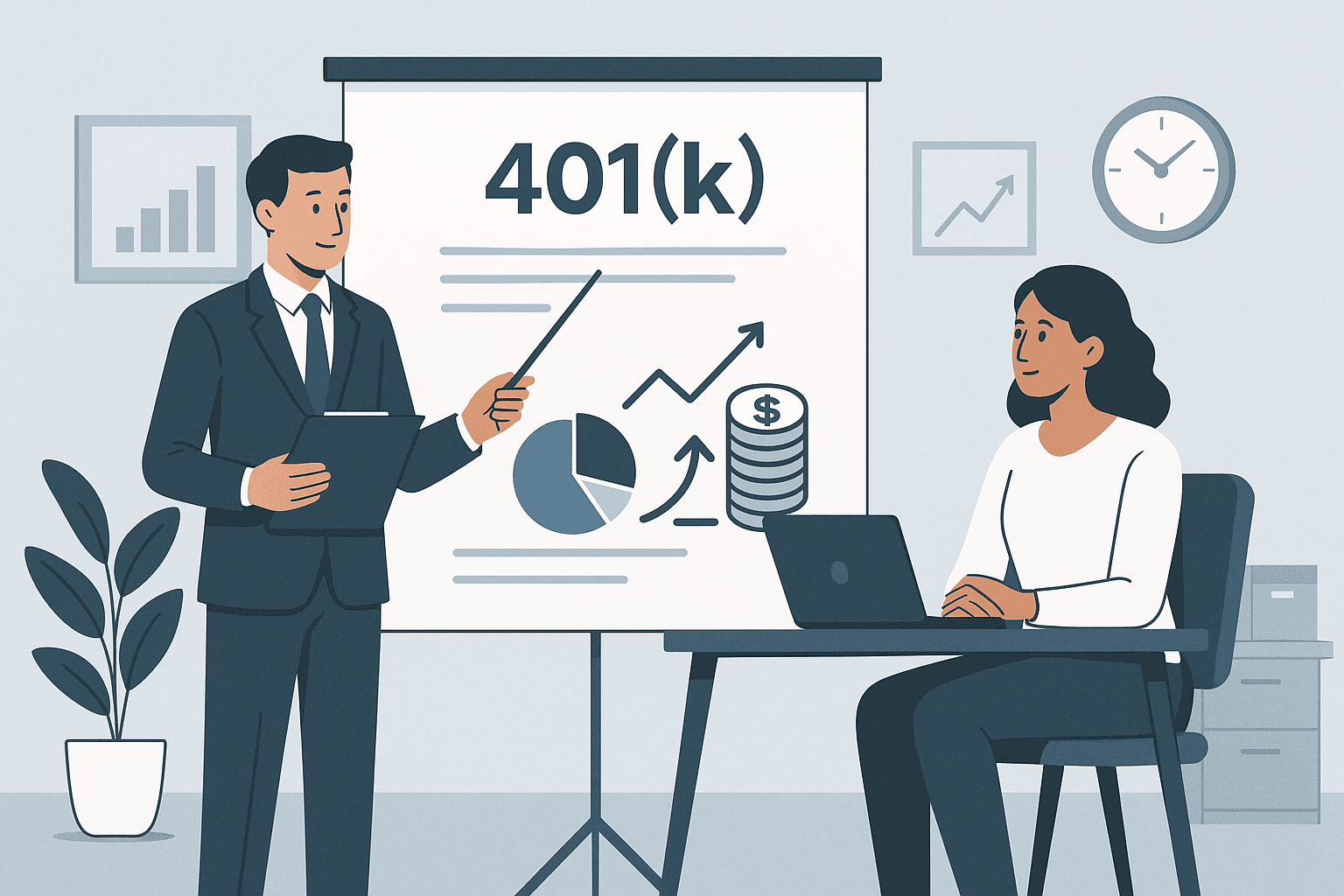
By the MoneySimple Editorial Team — reviewed for accuracy, June 2026
This guide is for educational purposes only and is not financial, tax, (learn more about 9 debt payoff methods that actually work — find the right one for your situation) (learn more about 10 tax deductions you shouldn't miss in 2026 (including 4 brand-new ones)) (learn more about 8 credit card debt payoff strategies that actually work in 2026) (learn more about 7 student loan forgiveness programs in 2026: are you eligible?) or investment advice. Contribution limits, tax rules, and plan features change, and the right move depends on your personal situation. Consider talking with a qualified financial (learn more about roth ira conversion strategy 2026: 7 steps to tax-free retirement income) (learn more about 7 best balance transfer credit cards in 2026 (0% apr up to 21 months)) or tax professional before making decisions. Results and outcomes vary.
A 401(k) is a retirement savings account offered through your employer that lets you set aside part of your paycheck before taxes are taken out, invest that money so it grows over decades, and pay taxes later when you withdraw it in retirement. For most working Americans, it is the single most powerful tool available for building long-term wealth — largely because of one feature almost no other account has: free money from your employer in the form of a match.
If you have ever looked at your pay stub, seen "401(k)" listed as a deduction, and quietly wondered what it actually does — this guide is for you. We will explain what a 401(k) is in plain language, how the money moves and grows, the difference between traditional and Roth versions, how much you can put in for 2026, and the exact steps to get started. No jargon, no judgment, and no assumption that you already know this stuff. Most people were never taught it.
By the end, you will understand your 401(k) well enough to make confident decisions about it — and you will know precisely what to do next.
What Is a 401(k)?
A 401(k) is an employer-sponsored retirement plan named after a section of the U.S. tax code. Here is the plain-English version: it is a special savings account, set up through your job, that gives you a tax break for saving money for retirement.
The deal the government offers is simple. Retirement is expensive, and Social Security alone usually is not enough to live on comfortably. So to encourage you to save on your own, the IRS lets you put money into a 401(k) and skip paying income tax on it now (or later, depending on the type). In exchange, the money is meant to stay invested until you are close to retirement age.
A few things make a 401(k) different from a regular savings account:
It is tied to your employer. You can only contribute to a 401(k) through a company that offers one. The money comes straight out of your paycheck automatically, before it ever hits your checking account.
The money gets invested, not just parked. Inside your 401(k), your contributions buy investments — usually mutual funds made up of stocks and bonds — that grow over time. This is what allows a modest monthly contribution to potentially become a substantial nest egg over a career.
There are tax advantages. You either avoid taxes now or avoid them later. Either way, your money grows without being taxed along the way, which lets it compound faster.
There are rules about access. Because the account is designed for retirement, taking money out early (generally before age 59½) usually comes with a penalty.
If your employer does not offer a 401(k), do not worry — there are alternatives like an IRA, which we cover later. But if you do have access to one, especially with an employer match, it is almost always the best place to start.
How a 401(k) Works
Understanding the mechanics removes most of the mystery. Here is the full life cycle of a dollar in your 401(k).
Step 1: You decide how much to contribute
When you enroll, you choose a contribution rate — usually a percentage of each paycheck, like 5% or 10%. Some plans let you choose a flat dollar amount instead. That percentage is automatically withheld from your pay every period and sent to your 401(k) account. You never have to remember to transfer it; it happens behind the scenes.
Step 2: Your contribution may lower your taxable income
With a traditional 401(k), the money comes out of your paycheck before income tax is calculated. So if you earn $4,000 in a paycheck and contribute $400, you are only taxed as if you earned $3,600. That is an immediate tax break — you are paying less to the government today. (With a Roth 401(k), the timing of the tax break is different; more on that shortly.)
Step 3: Your employer may add a match
Many employers contribute money to your account on top of what you put in. A common formula is "50% of the first 6% you contribute," or "100% match up to 4%." This is essentially a raise that only shows up if you participate. We will dig into why this matters so much below — it is the most important paragraph in this guide.
Step 4: The money gets invested
Your contributions do not just sit in cash. You select investments from a menu your plan offers — typically a mix of mutual funds and often a "target-date fund" that automatically adjusts as you age. As markets grow over the years, so does your balance. The earnings get reinvested, and those earnings then generate their own earnings. This snowball effect is called compounding, and it is why starting early matters so much.
Step 5: The money grows tax-deferred
While your money sits in the account, you do not pay any taxes on the growth — not on dividends, not on interest, not on gains when investments are sold inside the account. In a regular brokerage account you would owe taxes on that activity every year. Skipping that drag lets your balance grow noticeably faster over a multi-decade career.
Step 6: You withdraw in retirement
Once you reach age 59½, you can start taking money out without penalty. With a traditional 401(k), you pay regular income tax on each withdrawal (since you skipped the tax going in). With a Roth 401(k), qualified withdrawals are completely tax-free. Eventually, the IRS requires you to start taking minimum withdrawals — currently beginning at age 73 — so the money does not grow tax-sheltered forever.
That is the whole journey: paycheck in, employer match added, invested and growing tax-advantaged for decades, withdrawn in retirement.
The Employer Match: Why It Is Free Money
If you read only one section of this guide, make it this one.
An employer match is when your company contributes money to your 401(k) based on what you contribute. It is, quite literally, additional compensation you only receive if you put in your own money first. Walking away from it is like declining part of your salary.
Here is a typical example. Say your employer matches 100% of your contributions up to 5% of your salary, and you earn $50,000 a year.
If you contribute 5% ($2,500), your employer adds another $2,500. You have turned $2,500 into $5,000 the instant it hits your account — a 100% return before the money has even been invested. No investment on earth reliably doubles your money on day one. This does.
If you contribute nothing, you get nothing. That $2,500 from your employer simply does not happen. Over a 30-year career, consistently skipping a $2,500 annual match — and the growth it would have generated — can easily cost you well over $200,000 in retirement savings.
This is why nearly every financial professional gives the same first piece of advice: contribute at least enough to get the full employer match before doing almost anything else with extra money. It is the highest-guaranteed-return move available to most workers.
A quick note on vesting. Some employers require you to stay with the company for a certain period before their matching contributions are fully yours to keep — this is called a vesting schedule. Your own contributions are always 100% yours immediately. But the match might "vest" gradually, say 20% per year over five years. If you leave before you are fully vested, you forfeit the unvested portion. Check your plan documents so you know where you stand.
Traditional vs. Roth 401(k): The Two Types
Many plans offer two flavors of 401(k), and the difference comes down to one question: do you want your tax break now, or later?
Traditional 401(k): tax break now
Contributions go in before taxes, lowering your taxable income today. Your money grows tax-deferred. When you withdraw in retirement, you pay ordinary income tax on every dollar — contributions and growth alike.
Traditional tends to make sense if you expect to be in a lower tax bracket in retirement than you are now, or if you simply want to reduce your tax bill in your higher-earning years. Understanding where you fall today helps — our breakdown of the 2026 federal tax brackets can show you what bracket your income lands in.
Roth 401(k): tax break later
Contributions go in after taxes — you get no deduction today. But your money grows tax-free, and qualified withdrawals in retirement are 100% tax-free, including all the growth. You have already paid the tax, so the IRS leaves the rest alone.
Roth tends to make sense if you expect to be in the same or a higher tax bracket later, if you are early in your career with room to grow your income, or if you simply value the certainty of knowing your retirement withdrawals will not be taxed.
A simple way to decide
The honest answer is that nobody knows future tax rates for certain, which is why some savers split contributions between both to hedge. A reasonable rule of thumb: younger or lower-income now → lean Roth; higher-income now and expecting to spend less in retirement → lean traditional. Either choice is far better than not contributing at all.
Importantly, the employer match is almost always made on a traditional (pre-tax) basis, even if your own contributions are Roth — though under newer rules some plans now allow matches to be designated as Roth. So a Roth saver often ends up with a small traditional bucket from the match. That is normal.
2026 Contribution Limits
The IRS sets a cap on how much you can contribute each year, and these limits typically rise a little annually to keep pace with inflation. Here are the figures for the 2026 tax year.
Standard employee contribution limit: $24,500. This is the most you can put in from your own paycheck if you are under 50. (For comparison, the 2026 IRA limit is $7,500 — a 401(k) lets you save far more.)
Catch-up contribution (age 50+): an extra $8,000. If you are 50 or older at any point during the year, you can contribute an additional $8,000 on top of the standard limit, for a total of $32,500. This exists to help people closer to retirement accelerate their savings.
"Super catch-up" (ages 60–63): an extra $11,250. Thanks to the SECURE 2.0 law, savers who are 60, 61, 62, or 63 during 2026 get an even larger catch-up — $11,250 instead of $8,000 — bringing their personal contribution limit to $35,750. This enhanced catch-up is optional for employers to offer, so confirm your plan includes it.
Total combined limit (you + employer): $72,000. When you add your contributions to your employer's match and any other employer contributions, the grand total that can land in your account in 2026 is capped at $72,000 (before age-based catch-ups, which raise the ceiling further for older savers). Most people never approach this limit, but it is the outer boundary.
One rule for high earners. Starting in 2026, if you earned more than $150,000 in wages from your employer in the prior year, any catch-up contributions you make must go into a Roth (after-tax) account rather than a traditional one. This is a newer SECURE 2.0 provision, and your plan administrator handles the mechanics — but it is worth knowing if you are a higher earner who relies on catch-up contributions.
If you cannot hit these numbers, that is completely fine. The vast majority of savers contribute far less, and consistency over time matters more than maxing out. The limits simply tell you the ceiling.
Benefits and Drawbacks
A 401(k) is powerful, but it is not perfect for every dollar or every situation. Here is an honest look at both sides.
The benefits
The employer match is unbeatable. As covered above, no other savings vehicle hands you an instant guaranteed return like a match does.
The tax advantages are substantial. Whether you take the break now (traditional) or later (Roth), avoiding taxes on decades of investment growth meaningfully boosts your final balance.
It is automatic and painless. Money is withheld before you see it, which sidesteps the willpower problem that derails most saving. You adjust to living on what lands in your checking account.
The contribution limits are high. You can shelter far more in a 401(k) than in an IRA, making it ideal for serious savers.
It is portable. When you change jobs, you can roll your 401(k) into your new employer's plan or into an IRA without taxes or penalties. Your savings follow you.
The drawbacks
Your money is locked up. Withdrawing before age 59½ generally triggers a 10% penalty plus income tax. A 401(k) is not an emergency fund, which is exactly why you should build a separate one first — our emergency fund guide walks through how much you actually need.
Your investment choices are limited. You can only pick from the menu your plan offers, and some plans have mediocre or expensive fund options. (An IRA, by contrast, opens up the whole market.)
Fees can quietly eat returns. Some plans carry administrative fees and high-cost funds that, over decades, can cost you tens of thousands of dollars. It is worth reviewing your plan's fee disclosure.
Required withdrawals eventually kick in. With a traditional 401(k), the IRS forces you to start taking money out at age 73 (rising in coming years), whether you need it or not, and to pay tax on it.
You owe taxes on traditional withdrawals. The tax bill you deferred for decades comes due in retirement, which some savers underestimate.
For most people, the benefits decisively outweigh the drawbacks — especially when a match is on the table. But knowing the limitations helps you use the account wisely rather than blindly.
How to Get Started: A Step-by-Step Process
If you have access to a 401(k) and have not enrolled, or you enrolled years ago and have not touched it since, here is exactly how to get set up properly.
Step 1: Confirm you are eligible and enroll. Ask HR or your benefits portal whether you are eligible (some plans have a short waiting period for new hires). Many companies now auto-enroll you at a default rate, but that default is often too low. Either way, log in to your plan and confirm you are participating.
Step 2: Contribute at least enough to get the full match. Find your employer's match formula in your plan documents. If they match up to 5%, set your contribution to at least 5%. This is the non-negotiable minimum. Anything less leaves guaranteed money on the table.
Step 3: Choose traditional, Roth, or a split. Based on the comparison earlier, decide where your contributions go. If you are unsure and early in your career, Roth is a reasonable default. You can change this anytime.
Step 4: Pick your investments. This intimidates people more than it should. If your plan offers a target-date fund (named for the year closest to your expected retirement, like "Target 2055"), choosing it is a perfectly sound, hands-off option — it holds a diversified mix and automatically grows more conservative as you age. If you prefer more control, a low-cost broad-market index fund is another solid foundation.
Step 5: Set it and increase it over time. Once you are enrolled and invested, the system runs itself. The single best habit you can build is raising your contribution rate by 1% each year, or whenever you get a raise. You will barely feel it, and it dramatically increases your final balance. Many plans offer an "auto-escalation" feature that does this for you.
Step 6: Review once a year. You do not need to watch it daily — in fact, you should not. Once a year, log in to confirm your contribution rate, check that your investments still fit your timeline, and glance at the fees. That is it.
How to Choose Your Investments
Inside your 401(k), you are not buying individual stocks — you are choosing from a curated list of funds. Here is a framework for thinking about it, without needing an MBA.
Understand the main building blocks. Most plan menus contain a handful of categories: stock funds (higher potential growth, more ups and downs), bond funds (steadier, lower growth), and target-date funds (an all-in-one blend that shifts over time). Your mix of these is called your asset allocation.
Match your risk to your timeline. The longer until you retire, the more you can lean toward stock funds, because you have decades to ride out market dips. As you approach retirement, shifting toward bonds protects what you have built. Target-date funds handle this transition automatically, which is why they are such a popular default.
Favor low fees. Two funds can hold nearly identical investments but charge very different fees (expressed as an "expense ratio"). Over 30 years, a fund charging 0.10% versus one charging 1.00% can mean a difference of tens of thousands of dollars. When two options are similar, the cheaper one usually wins.
Diversify — do not bet on one thing. Spreading your money across many companies and asset types reduces the risk that any single bad investment sinks your savings. A broad index fund or target-date fund does this for you by design.
Keep it simple. You do not need ten funds. For most people, a single target-date fund — or a simple combination of a total-market stock fund and a bond fund — is more than enough. Complexity rarely improves results and often just adds fees and confusion. Once you are comfortable with the basics here, you may want to explore investing beyond your 401(k) using a robo-advisor or one of the better investing apps.
Common Mistakes to Avoid
Even people who diligently contribute often trip over these. Avoiding them puts you ahead of most savers.
Not contributing enough to get the full match. We have said it three times because it is the most expensive mistake of all. Leaving the match unclaimed is leaving a raise unclaimed.
Leaving money in cash. Some people enroll, contribute for years, and never realize their money was sitting in a low-yield cash or money-market option the whole time, barely growing. Confirm your contributions are actually invested in funds.
Cashing out when you change jobs. When you leave an employer, cashing out your 401(k) triggers taxes and a 10% penalty, and wipes out years of compounding. Instead, roll it into your new plan or an IRA. It takes a phone call and keeps your money working.
Borrowing or withdrawing early. A 401(k) loan or hardship withdrawal can feel tempting in a pinch, but it stalls your growth and can create tax headaches. Build a separate emergency fund so your retirement money stays untouched. If debt is the pressure point, our guide on how to get out of debt lays out a healthier path than raiding your retirement.
Setting it and forgetting it forever. "Set it and forget it" is great for the investments, but you should still raise your contribution rate over time and check in annually. A rate you set at 22 may be far too low at 35.
Ignoring fees. High plan fees are silent and easy to overlook, but they compound against you. Spend ten minutes reviewing your plan's fee disclosure at least once.
Costs and Fees
A 401(k) itself is generally free to open — your employer sets it up. But there are costs inside it that affect your returns, and it pays to understand them.
Investment (fund) fees. Every fund charges an expense ratio, a small annual percentage of your balance. Index funds are often very cheap (0.03%–0.20%), while actively managed funds can run 0.50%–1.00% or more. These are deducted automatically, so you never see a bill — which is exactly why they are easy to miss.
Administrative fees. Running the plan costs money, and some employers pass part of that cost to participants as a flat fee or a percentage of assets. In good plans this is small or covered by the employer; in weaker plans it can be a meaningful drag.
Why it matters so much. Because fees compound over decades, the difference between a low-cost and high-cost plan is enormous. As a rough illustration, on a balance that grows to several hundred thousand dollars, paying 1% per year more in fees can cost you well into six figures over a career. You cannot always change your plan's fees, but you can choose the lowest-cost funds on the menu, and you can roll old 401(k)s into lower-cost IRAs when you leave a job.
The takeaway: a 401(k) is one of the most cost-effective ways to invest, but only if you pay attention to the fees inside it rather than assuming they do not exist.
Frequently Asked Questions
What does 401(k) actually mean?
It is named after Section 401(k) of the U.S. Internal Revenue Code, the law that created this type of retirement account in the late 1970s. The name has no deeper meaning — it is just the subsection number.
How much should I contribute to my 401(k)?
At an absolute minimum, contribute enough to capture your full employer match. A widely cited target is 15% of your income (including the match) toward retirement, but if that is out of reach, start where you can and increase 1% a year. Consistency beats perfection.
What is the difference between a 401(k) and an IRA?
A 401(k) is offered through your employer, allows much higher contributions ($24,500 vs. $7,500 for 2026), and may include an employer match. An IRA is opened on your own through a brokerage, has lower limits, but offers a far wider range of investment choices. Many people use both.
Can I lose money in my 401(k)?
Yes — because the money is invested, your balance rises and falls with the markets, and it can drop in a downturn. But over long periods, diversified investments have historically trended upward. The risk of short-term dips is the price of long-term growth, which is why a 401(k) is meant for money you will not need for many years.
What happens to my 401(k) when I change jobs?
You have options: leave it in your old employer's plan, roll it into your new employer's plan, or roll it into an IRA. Rolling it over keeps the money growing tax-advantaged. Cashing it out, by contrast, usually triggers taxes and a 10% early-withdrawal penalty.
When can I take money out without a penalty?
Generally at age 59½. Withdrawals before then typically incur a 10% penalty plus income tax, with some exceptions (such as certain hardships or leaving your job at age 55 or later). Traditional withdrawals are taxed as income; qualified Roth withdrawals are tax-free.
What is a vesting schedule?
It is the timeline over which your employer's matching contributions become fully yours. Your own contributions are always 100% yours immediately, but the match may vest gradually over several years. If you leave before you are fully vested, you forfeit the unvested portion.
What is an employer match?
It is money your employer adds to your account based on what you contribute — for example, matching 100% of the first 5% of salary you put in. It is effectively free money and an instant return on your contribution, which is why claiming the full match should be your first priority.
Should I choose a traditional or Roth 401(k)?
Choose traditional if you want a tax break today and expect a lower tax rate in retirement. Choose Roth if you would rather pay tax now and take withdrawals tax-free later, which often suits younger or lower-income savers. When in doubt, some savers split contributions between both.
What are the 2026 contribution limits?
You can contribute up to $24,500 from your paycheck in 2026 if you are under 50, plus an $8,000 catch-up if you are 50+ (total $32,500), or an $11,250 catch-up if you are 60–63 (total $35,750). The combined limit including employer contributions is $72,000.
What is a target-date fund?
It is an all-in-one investment named for your expected retirement year (like "Target 2060"). It holds a diversified mix of stocks and bonds and automatically becomes more conservative as you near retirement. It is a sound, hands-off default for savers who do not want to manage investments themselves.
Do I have to take money out at a certain age?
Yes, for traditional 401(k)s. The IRS requires "required minimum distributions" (RMDs) starting at age 73 under current law. Roth 401(k)s no longer require withdrawals during the original owner's lifetime under recent rule changes.
Is a 401(k) worth it if my employer does not match?
Often, yes — the tax advantages alone make it valuable. But without a match, it is worth comparing it to an IRA, which may offer lower fees and more investment choices. A common approach is to use the IRA first if there is no match, then the 401(k) for additional savings.
Can I have a 401(k) and an IRA at the same time?
Yes. Many people contribute to both to maximize tax-advantaged savings. There are income rules that can affect whether your IRA contributions are tax-deductible if you also have a 401(k), so it is worth checking your situation.
Conclusion: Your Next Steps
A 401(k) can feel intimidating from the outside, but underneath the code-section name it is a straightforward and remarkably effective tool: money goes in from your paycheck, your employer often adds more, it grows tax-advantaged for decades, and it funds the retirement you actually want.
If you take nothing else from this guide, take these three actions. First, contribute at least enough to capture your full employer match — that is the highest-return move available to most workers. Second, make sure your money is actually invested, ideally in a low-cost, diversified option like a target-date or broad index fund. Third, raise your contribution rate a little each year and review it annually.
That is genuinely most of what successful retirement saving comes down to. Not timing the market, not picking the perfect fund — just starting, claiming the match, and staying consistent.
From here, it helps to see how your 401(k) fits into the bigger picture. Make sure you have built a separate emergency fund so you are never forced to raid your retirement, understand which tax bracket you are in to inform your traditional-vs-Roth choice, and once your match is secured, explore additional investing through a robo-advisor or investing app. If high-interest debt is holding you back from contributing, tackling it first using our debt payoff guide clears the runway.
You do not need to be a finance expert to retire comfortably. You just need to start — and now you know how.
More Guides From This Site
- 10 Tax Deductions You Shouldn't Miss in 2026 (Including 4 Brand-New Ones)
- How to Get Out of Debt: The Complete Step-by-Step Guide
- What Is a Roth IRA and How Does It Work? Rules, Limits, and Benefits (2026 Guide)
- What Is Life Insurance? How It Works, Types, Costs, and How to Choose (2026 Guide)
- 7 First-Time Home Buyer Down Payment Assistance Programs You May Qualify For in 2026
- 7 Student Loan Forgiveness Programs in 2026: Are You Eligible?
- 8 Best Auto Insurance Companies in 2026 (Ranked by Cost, Coverage & Claims)
- 8 Proven Strategies to Stop Living Paycheck to Paycheck (That Actually Work)
- 9 Passive Income Ideas That Actually Generate $500-$2,000 a Month
- 9 Passive Income Ideas That Actually Work in 2026 (Ranked by Effort and Risk)
- Best 401(k) Rollover Companies of 2026: Where to Move Your Old Retirement Account
- Best ACA Marketplace Health Plans for 2027: How to Choose
- Best Auto Loan Rates of 2026: Where to Find the Lowest APR
- Best Bill Negotiation Services in 2026: 6 Options Ranked by Fees and Fit
- Best Budgeting Apps 2026: Ranked by Features, Cost & Mint Alternatives
- Best Checking Accounts of 2026: Top 8 for Low Fees, High APY, and Bonuses
- Best Crypto Exchanges for 2026: 7 Platforms Compared
- Best Fee-Only Financial Advisors in 2026: 7 Ways to Find a True Fiduciary
- Best Health Insurance for the Self-Employed in 2026: Top 7 Options
- Best Identity Theft Protection Services in 2026: 7 Options Compared
- Best Long-Term Disability Insurance Companies in 2026: 7 Options Compared
- Best Money Transfer Apps in 2026: 7 Services Compared
- Best No-Exam Life Insurance Companies of 2026: 7 Options Compared
- Best Payroll Software for Small Business in 2026: 7 Services Compared
- Best Renters Insurance Companies of 2026: Top 7 Compared
- Best Term Life Insurance Companies 2026: 7 Top Picks Ranked by Value and Reliability
- Best Umbrella Insurance Companies of 2026: 7 Insurers Compared
- Best Wealth Management Firms in 2026: 8 Top Companies Compared
- Buy Now, Pay Later Apps Compared: Are These 7 BNPL Services Worth the Risk in 2026?
- Emergency Fund Calculator: A 9-Step Action Plan to Build Yours in 2026
- Emergency Fund Calculator: How Much Do You Actually Need in 2026?
- Healthcare Costs Are Exploding: How 9 Canadians Are Fighting Back
- How to Negotiate Salary in 2026: A Step-by-Step Guide
- HSA vs FSA vs HRA: The 7-Factor Comparison That Could Save You $3,000 a Year
- The 2026 Insurance Gap: 8 Policies Most Canadians Are Missing (That Cost Them Thousands)
- The Great Rebalancing: 8 Portfolio Adjustments to Make Before Market Volatility Hits
- The Mortgage Refinancing Trap: 6 Reasons You're Paying More Than You Should
This content is for educational purposes only and does not constitute financial advice. Consult a licensed financial professional for advice specific to your situation.
MoneySimple may receive compensation from partners featured on this page. This does not influence our editorial opinions or recommendations.
Related articles
More guidance you might find helpful.

6 Best Student Credit Cards in 2026: Ranked for Cash Back and Credit Building
Compare six no-annual-fee student credit cards ranked by rewards, approval accessibility, and credit-building features, with tips for first-time cardholders.
Debt Snowball vs. Debt Avalanche: Which Payoff Method Works Faster?
The debt snowball and debt avalanche methods compared on total interest paid, time to debt-free, and real-world completion rates, plus a hybrid approach that blends both.

How Credit Cards Work: A Complete Guide to Interest, Rewards, Fees, and Choosing a Card
A credit card is a revolving line of credit: you borrow from a bank to pay for things, then either repay the full statement balance by the due date and owe no interest, or carry the balance and pay interest on it. Here's how billing cycles, APRs, grace periods, rewards, fees, and credit-score effects actually work — with current 2026 numbers.
Get smarter about money.
Free weekly tips on credit, debt, taxes, and more.
No spam. Unsubscribe anytime.
